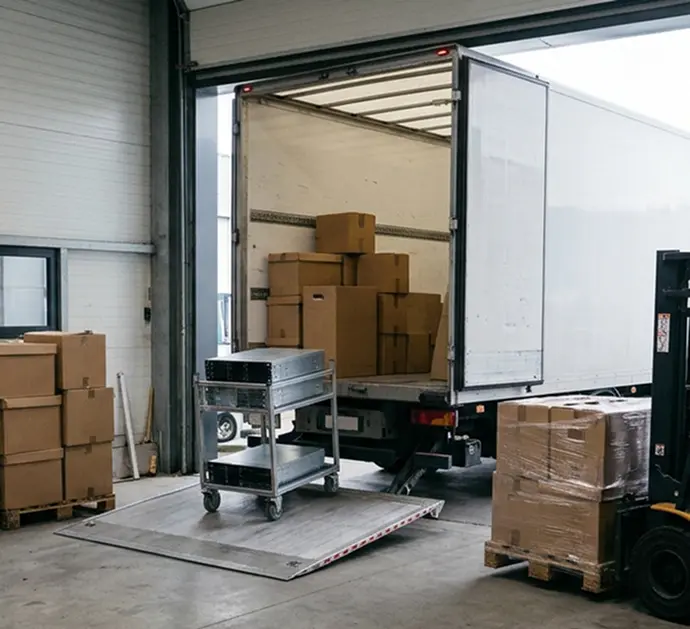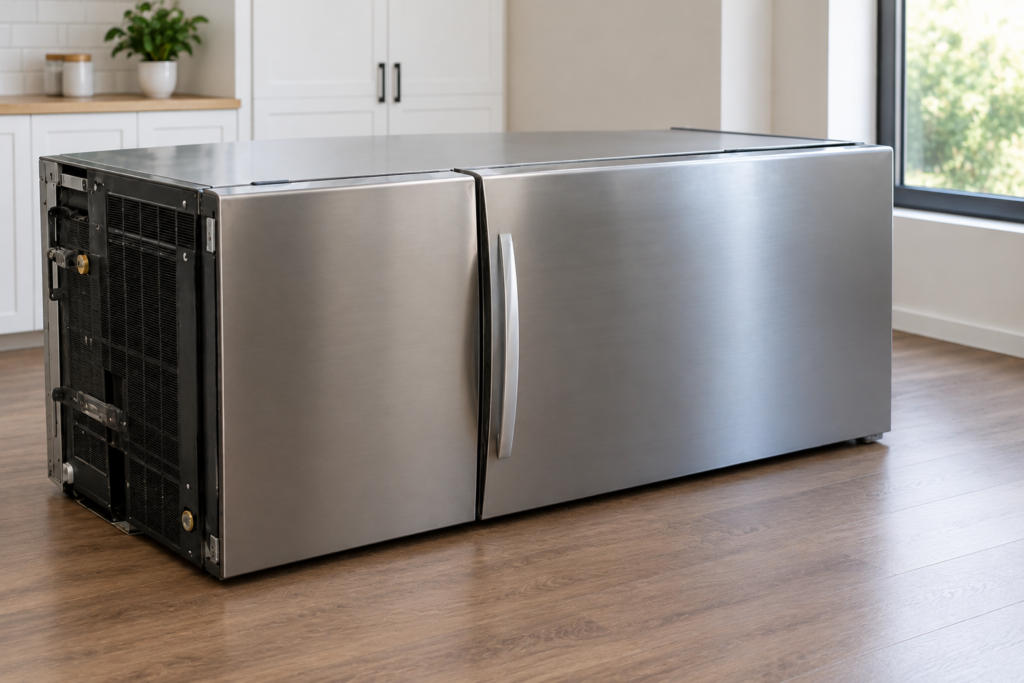
The hallway is narrow, the truck bed is short, and somebody on the crew says the refrigerator will just have to go down on its side. It sounds harmless, but it is the kind of decision that can show up three days later as a fridge that hums, struggles and never gets cold. The same appliance can survive a trip on its side perfectly well when a few conditions are met, so the answer depends on knowing which conditions those are.
Here is the short version. Upright is always the best way to move a refrigerator. Some models can be laid down when there is no other option, and for those the side matters. Others, including French-door and bottom-freezer styles, should stay upright the whole way. Whatever you do, the refrigerator then needs to stand upright and unplugged for a while before it runs again.
This guide covers the reasoning behind that advice, which models can lie down and on which side, how long to wait before plugging in, and how to avoid the mistakes that cost people a working appliance.
Quick answer: which refrigerators can lie down
| Type of refrigerator |
Can it lie down if there is no alternative? |
Which side |
| Top-freezer |
Yes |
The side opposite the door hinges, so the door stays shut |
| Side-by-side (freestanding) |
Yes |
The freezer side |
| French-door |
No, keep it upright |
Tilting briefly to clear a doorway is acceptable |
| Bottom-freezer |
No, keep it upright |
Tilting briefly to clear a doorway is acceptable |
| Built-in |
Follow the built-in instructions in the manual, which generally call for upright transport |
A dolly tilt is not the same as laying it down |
This table follows the published moving instructions from GE Appliances. Other brands can differ in the details, so treat it as a strong default rather than a universal rule, and check the manual for your exact model before anything leaves the kitchen.
Why upright is the default
A refrigerator is built around a sealed system. At the center sits the compressor, and inside the compressor is a small amount of oil that lubricates its moving parts. That oil is meant to stay in the compressor. When the appliance is tilted far enough or laid on its side, the oil can travel into places it does not belong, including the lines that carry refrigerant. If the refrigerator is then switched on before the oil has had time to drain back, the compressor may run without the lubrication it expects and the refrigerant can circulate badly.
LG describes this directly in its support material: tilting the refrigerator during transport can send the oil in the wrong direction, and powering the unit on right away may cause a malfunction. LG also points to a second hazard that has nothing to do with oil. A refrigerator moved while lying down can suffer from vibration, which may loosen the compressor or crack a gas pipe, and a damaged line can mean a refrigerant leak. GE puts the same idea in plain terms: keeping the unit standing upright minimizes possible damage to the sealed system and to loose items inside.
None of this means a fridge is ruined the moment it touches its side. It means that every sideways minute adds risk, and that the recovery time afterward is the part you control.
Which models can be laid down, and on which side
The right answer depends on how the refrigerator is built. Door layout, hinge position and compressor placement all matter, which is why generic advice that says “just use a side” is not good enough.
Top-freezer models
A top-freezer unit can go on its side if it has to. Lay it on the side opposite the hinges. With the hinge side up, gravity pulls the door toward the cabinet and keeps it closed. The other way around, the door is more likely to swing open during the ride. Even on the correct side, secure the doors with straps or stretch wrap, because shifting in transit can pop them loose.
Side-by-side models
A freestanding side-by-side should be placed on its freezer side. The freezer door is typically heavier and holds shut more reliably, while the fresh-food door is more likely to open under load. Built-in side-by-side units are the exception and follow the rules for built-ins instead.
French-door and bottom-freezer models
These styles should stay upright for the entire move. They may be tilted when necessary to fit through a doorway, but they should not be laid down for transport. If a French-door unit does not fit upright through the access route, that is a planning problem to solve before moving day, not a reason to improvise on the truck.
Built-in refrigerators
Built-in models are heavier, more complex and often fitted with panels that are expensive to replace. They generally travel upright, and the built-in section of your manual is the final word. Tilting them on a dolly during handling is normal, and it is a different thing from laying the whole unit on its side in a truck.
Compact and mini refrigerators
Small units are lighter, but the same compressor logic applies. Keep them upright when possible, and treat any sideways time as a reason to wait before plugging in.
Freezers
Upright and chest freezers follow related guidance. GE advises keeping a freezer upright, and if that is not possible, laying it down on the compressor side, securing the door and then letting it stand for as long as it was on its side, up to 24 hours.
Tilting is not the same as laying down
People often treat these as the same thing, and the difference matters. Tilting a refrigerator back on a dolly to roll it along a hallway, or leaning it to clear a doorframe, is part of normal moving technique. Laying it down means placing it on its side or back and leaving it there, whether in a truck bed, a van or a tight stairwell.
A few habits keep tilting safe:
- Use a dolly or hand truck from the side rather than from the front or back, which protects the door and the rear coils.
- Keep the angle as shallow as the doorway allows and return to vertical as soon as you clear it.
- Use straps to hold the unit to the dolly so it cannot slide.
- Have a second person guiding the top.
If you find yourself needing a steeper angle than a dolly can manage, that is a sign the route needs rethinking.
How long to wait before plugging it in
The waiting period is where most guidance becomes confusing, because the numbers you will see online range from a couple of hours to a full day. The reason is that different manufacturers publish different instructions, and the time on its side changes the answer.
GE’s published rule is specific. If the refrigerator traveled on its side, stand it upright for the same amount of time it spent on its side before plugging it in, and if it was on its side for more than a day, let it stand for 24 hours. LG’s support pages for at least one market are more conservative about even short sideways time: they recommend waiting at least about 2 hours if the unit was laid down, even if it was only on its side for around ten minutes. Other sources recommend more.
| What happened during the move |
What published guidance suggests |
| Stayed upright the whole time |
Little or no waiting beyond letting vibration settle. Check the manual for your model. |
| Laid down briefly, under an hour |
At least as long as it was down under the GE rule. LG’s guidance suggests about 2 hours. Use the longer figure. |
| Laid down for several hours |
Equal time upright at a minimum. A full day is the safer margin. |
| Laid down for more than a day |
24 hours upright before running. |
| You are unsure how long it was down, or which brand rule applies |
Wait 24 hours. Many guides use this as the conservative default. |
A few practical notes make the table easier to use. Both the manual and the manufacturer’s support page can list a brand-specific figure, and it is worth reading before the truck even arrives. If the instructions conflict, the longer wait costs you nothing but patience, while a short wait can cost you the compressor. Move day is also not the day to discover that food is warming up, so plan coolers in advance.
Prepare the refrigerator for any kind of move
Preparation reduces the chance that you will need the sideways option at all, and it protects the unit if you do.
- Check the route first. Measure the refrigerator, then measure doorways, hallways, stairwell turns and the truck opening. A French-door model that fits upright through every opening never has to go down.
- Plan the timing. Decide how long the unit will be out of service and where the food will go, whether that is coolers, a second fridge or a short stay with a friend.
- Unplug it ahead of time. Switch it off or unplug it several hours before the crew arrives so the evaporator has time to defrost. Ice that melts during the trip makes a mess in the truck.
- Empty and clean it. Remove food, clean the interior and leave the doors propped open briefly so it can dry.
- Secure the loose parts. Remove or lock down shelves, bins and drawers so they do not break or scrape the interior. Tape or strap the doors shut.
- Deal with water lines. If the refrigerator has an ice maker or water dispenser connected to a supply line, shut off the water and disconnect it following the manual.
- Wrap the exterior. Moving blankets protect the finish from scratches and dents.
- Wrap the cord. Tie it up so it does not drag or catch on the dolly.
Loading and securing it in a truck or van
How the refrigerator rides is as important as how it is carried to the vehicle.
- Load it standing. A refrigerator on rollers can shift unexpectedly, so strap it to the truck wall or a tie-down track so it cannot roll.
- Pad the sides and door with blankets, and make sure nothing heavy can lean against it.
- Keep boxes and other heavy items off the top of it.
- Check the straps again after the first few turns, because loads settle.
- Drive smoothly. Hard braking and fast corners are what push an unsecured appliance off its dolly.
If an upright ride is impossible because of the vehicle’s height, the safer fix is usually a different vehicle, not a sideways refrigerator.
If it has to go on its side
Sometimes there really is no alternative. The access is too tight, the truck is too short, or the move is already happening. In that case, treat it as a controlled exception.
- Confirm that your model is allowed on its side. French-door, bottom-freezer and built-in units are not.
- Use the correct side for your type, which is opposite the hinges for a top-freezer and the freezer side for a side-by-side.
- Avoid resting it on the front or the back. Published guidance points to a side.
- Secure the doors with tape or wrap so they cannot open.
- Pad it on all sides and strap it so it cannot slide.
- Keep the time on its side as short as you can, and note when it went down and when it came back up.
- Stand it up as soon as you arrive, keep it unplugged and wait for the period that applies, using the table above.
- Plug it in only after the wait is complete, then give it time to cool before restocking.
The note about timing is not busywork. If you know it was down for two hours, you can plan to wait at least two hours, and if you are unsure, you can fall back on 24 hours.
What to do if it was plugged in too soon, or laid down by mistake
Mistakes happen. A helper lays the fridge down without asking, or someone plugs it in the moment it is back in place. The best response is calm and quick.
- Unplug it right away and let it stand upright for the full period that applies.
- Look for visible damage. Check for oil spots, bent or kinked tubing at the back, or loose parts. If you see tubing damage, do not plug it in.
- Read the manual or the support page for your model before restarting.
- Give it time to cool. A refrigerator can take hours to reach its normal temperature, and a freezer can take longer. Do not judge it after twenty minutes.
- Call for service if it never gets cold, or if it makes unusual noises after a full waiting period. A technician can diagnose a sealed system problem, and guessing at one rarely helps.
Avoid switching the power on and off repeatedly while troubleshooting. Follow the manual’s guidance instead.
Common mistakes
- Assuming every model can lie down. French-door and bottom-freezer units generally cannot, and laying them down can cause problems the wait time will not fix.
- Choosing the wrong side. Top-freezers go opposite the hinges and side-by-sides go on the freezer side. Front and back are not options.
- Skipping the wait. The most common failure is plugging in at once because the kitchen is ready and the food is waiting.
- Forgetting the doors. An unsecured door swings open in transit and can be damaged or take other items with it.
- Not securing the unit in the truck. A rolling refrigerator is dangerous for the people and the cargo around it.
- Moving it full. Food adds weight and makes defrosting a mess.
- Ignoring the manual. Brand and model instructions are the most reliable source, and they take two minutes to read.
When it is worth bringing in professionals
A refrigerator is one of the heaviest, most awkward items in a home, and it often sits in the part of the kitchen with the tightest access. Some jobs are routine for a trained crew and a hazard for anyone else: a French-door model that needs to stay upright on a staircase, a built-in unit with custom panels, a high-end appliance with delicate finishes, or a walk-up building where every turn is tight.
Experienced crews arrive with the equipment to handle those situations, such as appliance dollies, straps and blankets, and they plan the route before lifting. They also know that the upright rule is easier to follow with the right people and tools than it is with improvised ones. If you are weighing how much of a move to handle yourself, our guide to moving heavy furniture safely covers technique for oversized pieces, and the moving safety checklist lists the gear and habits that prevent injuries.
A refrigerator that works after the move
The refrigerator rule comes down to three habits: keep it upright whenever the route allows, use the correct side only when it truly cannot, and give it time before it runs again. Those habits cost almost nothing on moving day and protect an appliance that is expensive to replace. If your move includes appliances, our trained crews handle furniture and appliances on local moves, from safe loading to unloading, and you can see what that includes on our local moving page.