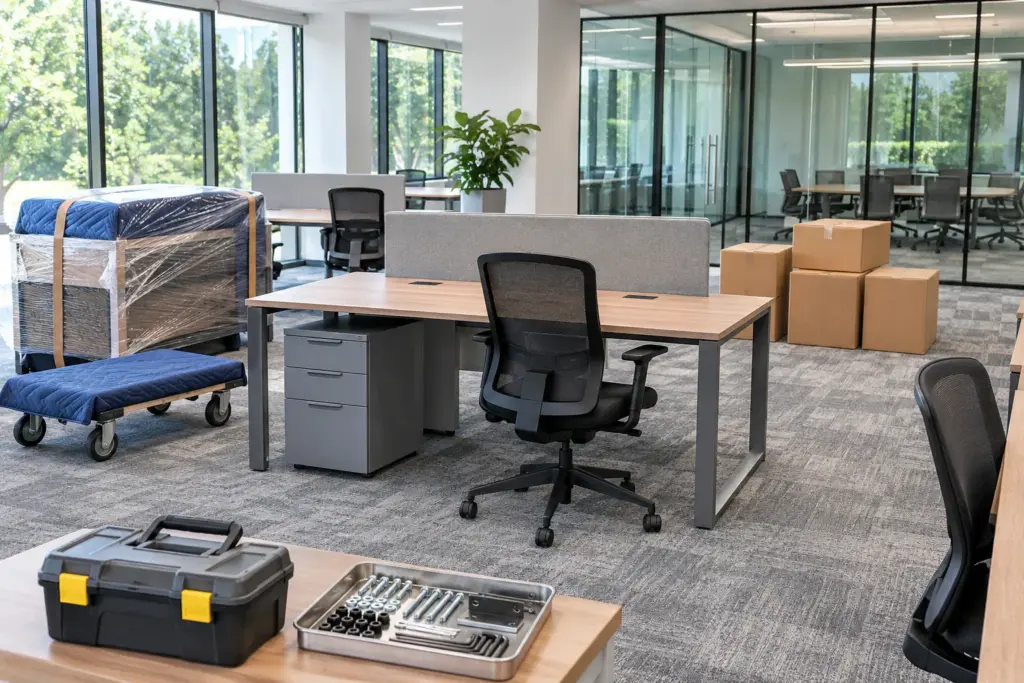
A data center relocation is decided long before the first rack is unbolted. The projects that finish on schedule have three things in common: every dependency was mapped before the move date was set, every cutover step has an owner and a rollback point, and the physical journey of each server is tracked like a chain of custody. The projects that stall usually skipped one of the three.
This checklist splits the work into seven phases, from scoping to decommissioning the old site. It is written for IT managers, facilities leads and operations directors who need a plan they can hand to a team, whether the room in question is a corporate server room, a colocation cage or a full on-premises hall.
Who owns what in a data center move
A relocation touches more teams than most companies expect, and the gaps between them cause more trouble than the hardware does. Settle ownership before anything else.
| Workstream |
Typical owner |
What they deliver |
| Project management |
Project manager or IT director |
Scope, budget, schedule, status reporting, go/no-go decisions |
| Logical migration |
Infrastructure and network engineers |
Dependency map, runbook, IP and DNS plan, rollback procedures |
| Applications |
Application owners |
Test scripts, acceptable downtime, sign-off after cutover |
| Site and power |
Facilities or colocation provider |
Power, cooling, floor loading, access and delivery rules at both ends |
| Physical transport |
Commercial moving company |
Packing, loading, transport, unloading, custody log |
| Security and compliance |
Security officer or compliance lead |
Data handling rules, media destruction, audit trail |
The line that matters most is the one between the logical move and the physical move. Your engineers decide what is shut down, in which order and how it comes back. The moving company executes the physical leg under those instructions. A mover should never be asked to decide the shutdown sequence, and an engineer should not spend moving night carrying chassis. Keeping that boundary clear makes both halves faster.
Phase 1: Scope, risk and budget
Start by defining what “moving” means for this project. There are three common versions, and they carry very different risk.
- Move as is: the same hardware, powered down at one site and powered up at another.
- Move and refresh: old hardware is retired and replaced during the relocation. This adds configuration risk, because new equipment changes variables you could have held constant.
- Migrate, then decommission: new infrastructure is built at the destination and workloads move over while the old site keeps running.
Infrastructure engineering guides generally advise against refreshing hardware in the same window as the move, because a failure afterward is hard to attribute. If a refresh is on the roadmap anyway, schedule it either well before or well after the relocation.
Then put numbers around the business impact:
- For each service, write down the maximum downtime the business can tolerate and the maximum data loss it can accept. These are your recovery time and recovery point objectives.
- Identify the contract deadlines at the old site: lease end, colocation notice period, equipment support renewals.
- List what the project cannot touch: freeze periods, quarter-end closes, seasonal peaks.
- Set a budget that includes the parts that tend to be forgotten: duplicate running costs during overlap, temporary circuits, new cabling, insurance, and a contingency line.
Timeline expectations deserve honesty at this stage. One infrastructure engineering guide puts a typical mid-sized migration at six to twelve months from planning to decommissioning, with smaller lift-and-shift projects measured in weeks. Your own number will depend on the size of the estate and how clean the documentation is. What matters is that the schedule is built from the inventory and the dependency map, not from the date the lease happens to expire.
Phase 2: Discovery and dependency mapping
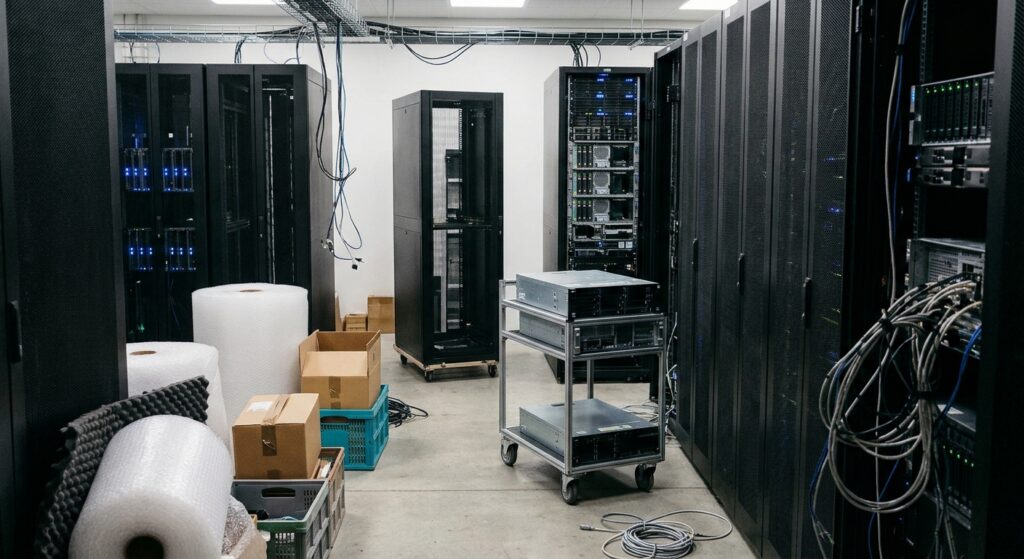
The most common cause of a failed migration, according to the same engineering guidance, is inadequate discovery. The hardware inventory is the easy part. The hard part is finding what the hardware quietly depends on.
Build the inventory
Capture one record per asset, and keep it in a system that survives the move, such as a configuration management database or at minimum a controlled spreadsheet.
| Field |
Why it matters |
| Make, model, serial number |
Matches the asset at origin and destination; needed for insurance and warranty |
| Rack, rack unit position, rail kit |
Lets the team rebuild the layout and reuse the right rails |
| Weight and dimensions |
Decides lift equipment, crew size and elevator suitability |
| Power draw and plug type |
Feeds the power plan at the destination |
| Network ports and cable map |
Rebuilds connectivity without guessing |
| Firmware and configuration baseline |
The reference for post-move comparison |
| Application and owner |
Tells you who signs off and who gets called |
| Criticality and wave |
Sets the order of the move |
Photograph the front and rear of every rack, the cable runs and the drive bay order before anything is disconnected. Photographs settle arguments at 2 a.m. about which cable went where.
Find the hidden dependencies
Inventory tells you what exists. Dependency mapping tells you what breaks when something moves. Four techniques work together:
- Interview application owners. Ask what each system talks to, what it runs overnight and what it needs at month-end.
- Search configuration files and scripts for hardcoded IP addresses and hostnames. These are the dependencies nobody remembers writing.
- Capture network traffic during peak hours and at the close of the financial period, not on a quiet Tuesday. A nightly batch job that only fires on the last day of the month will not show up in a sample taken mid-month.
- Check licensing. Some software is tied to hardware identifiers, host names or fixed IP addresses and stops working when those change.
Group tightly coupled systems into the same wave. An application server and its database belong in the same move, not in waves a week apart. The guide cited above describes a case in which a missed nightly batch job broke month-end reporting after an otherwise clean migration. The hardware was fine. The map was incomplete.
Phase 3: Design the destination
Everything the new room needs should be proven before equipment leaves the old one. Walk through this list with facilities or your colocation provider:
- Power: capacity per rack, redundant feeds, plug and circuit types, and a confirmed mapping between rack positions and power feeds.
- Cooling: heat load per rack against what the room can remove, plus airflow direction and containment.
- Floor and structure: floor loading for the heaviest racks, ramp or lift access, door and corridor clearances.
- Network: IP and VLAN plan, firewall rules, DNS changes, upstream circuits. Carrier circuits are often the longest lead item in the whole project, so order them first.
- Cabling: structured cabling in place, labeled and tested before arrival.
- Monitoring: hardware health, temperature, power and application monitoring ready to switch on the moment equipment is energized.
- Access and delivery rules: who may enter, when, with which badges, and how deliveries are announced. Colocation facilities commonly require inbound shipments to be scheduled in advance, and unannounced deliveries can be delayed or refused.
If the destination can host some pre-staged network gear, build that first. A destination core network that already works removes an entire category of problems from move night.
Phase 4: Write the runbook and the rollback plan
The runbook is the document the whole project hangs on. Every line should have an owner, an estimated duration, a verification step and a decision rule.
| Step |
Owner |
Duration estimate |
Verification |
If it fails |
| Lower DNS TTL values |
Network engineer |
Days before cutover |
New TTL visible in queries |
Reschedule cutover |
| Final backup, stored off the transport vehicle |
Backup administrator |
Per data volume |
Restore test passes |
Stop; do not proceed |
| Stop applications cleanly, drain traffic |
Application owner |
Per application |
No active sessions |
Escalate to project manager |
| Power down in dependency order |
Infrastructure engineer |
Per wave |
Hardware status confirmed off |
Hold wave |
| Hand over to movers, log custody |
Project manager and mover lead |
Per wave |
Package count and seals match log |
Quarantine package |
| Power on at destination, compare baseline |
Infrastructure engineer |
Per wave |
Logs match pre-move baseline |
Invoke rollback checkpoint |
| Application acceptance tests |
Application owner |
Per application |
Test script passes |
Invoke rollback checkpoint |
Three habits separate good runbooks from decorative ones.
Define go/no-go checkpoints in advance. Decide before the move what failure looks like: a critical application failing health checks, response times above an agreed threshold, a security alert. Write these abort triggers into the runbook so that nobody has to negotiate them at 3 a.m. under pressure.
Document the rollback in the same detail as the move. If the plan includes reverting DNS or restarting legacy systems, list the exact commands and the people who run them. A rollback that exists only as “we will go back if needed” is not a plan.
Test the rollback. A rehearsal on non-production systems, or a dry run of a small wave, exposes the steps that were missing on paper.
Communication belongs in the runbook too. Name who informs staff, customers and vendors, at which points, and through which channel. People forgive planned downtime that was announced. They do not forgive surprises.
Phase 5: Prepare the equipment for transport
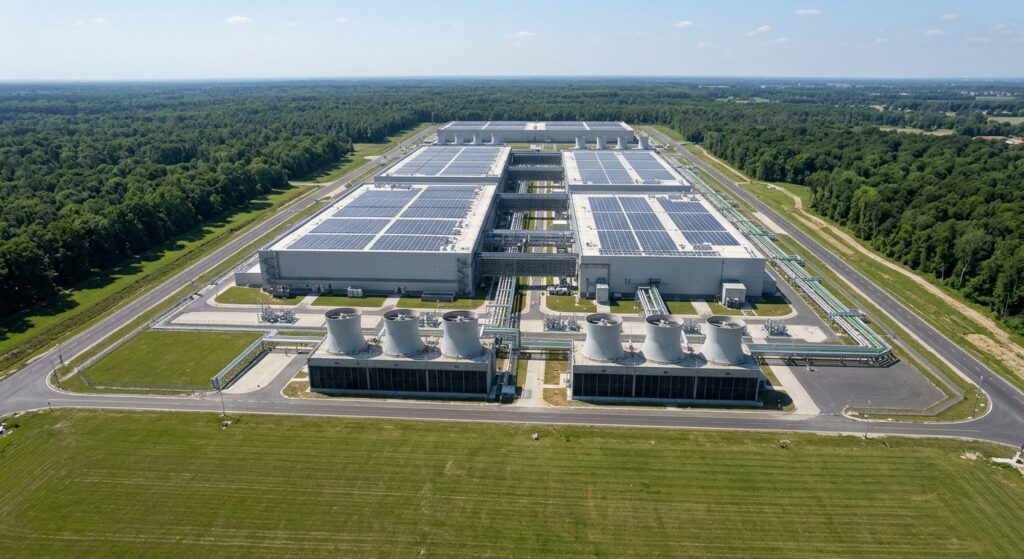
This phase connects the engineers to the movers. Preparation done well makes the moving day uneventful.
Before shutdown
- Create and test a backup, and keep it somewhere other than the vehicle carrying the hardware. Store encryption keys and recovery contacts separately from the backup itself.
- Make sure storage writes and replication have finished before anything is powered down.
- Capture health logs, drive status, firmware versions and configuration as the baseline you will compare against when the system comes back.
Packing and protection
- Use the manufacturer’s original packaging with fitted foam when it is approved for the configuration. Otherwise use purpose-built server transport cases rated for the weight and the type of journey.
- Pack drives with individual antistatic protection and cushioning. Loose fill such as packing pellets, air bags or crumpled paper does not protect a drive and can shift in transit.
- Remove or separately secure heavy components that the vendor marks as transport-sensitive.
- Bag and label rails, bezels, optics and screws in compartments, and cap connectors and fiber ends.
- Do not ship a fully loaded cabinet unless the rack, rails, hard-mount hardware, vehicle and carrier are all rated for it. Ordinary slide-rail latches are not designed to hold a populated rack through a road journey.
Labeling and custody
Each sealed package should carry an asset ID, a package number out of the total (“2 of 5”), the destination site and the delivery contact, along with gross weight and handling orientation. Use tamper-evident seals where your security policy calls for them. Keep passwords, network details and full inventories off exterior labels, since a label is visible to everyone who handles the box.
Then create a custody log that records who released each package, who carried it, who received it and who opened it. The log is boring until a package goes missing, and then it is the only document that matters.
Retired equipment
Some hardware will not move. Storage media from retired systems should be sanitized or destroyed according to a recognized standard before it leaves your control. NIST Special Publication 800-88, Guidelines for Media Sanitization, is the common reference, and its current revision was published in September 2025. If the data is regulated, such as health records, the sanitization record becomes part of your compliance evidence.
Phase 6: Moving day
Most of the physical risk is concentrated in a few hours. Preparation at both ends decides whether those hours are calm.
Confirm the site logistics at origin and destination: loading dock height, liftgate or ramp, elevator dimensions and weight limits, door widths, floor protection, security procedures and after-hours access. Verify these in person or with photographs, not from memory.
Choose a carrier experienced with high-value electronics. Ask what vehicles they use, how equipment is secured, how many people are on the crew and who the single point of contact is on the night. A crew that handles office furniture all day and a crew that handles servers are not interchangeable without briefing.
Use shock and tilt indicators as evidence, not as protection. They record that a package was mishandled. They do not prevent it. Good packaging and careful handling prevent it.
Control the timeline. Moving waves should follow the runbook, not the clock. If the first wave runs late, the plan should say what shifts and who decides.
Reconcile at arrival. Before anything is opened, check seals, package counts and serial numbers against the custody log. Photograph any crushed corners, water damage, broken indicators or signs of tampering before the package is moved or opened. Claims depend on this evidence, and it is easiest to gather in the first minutes.
A commercial moving company that handles IT and equipment-heavy relocations, like the team at Rise Up Moving, can manage the packing, transport and unloading of servers and sensitive electronics while your engineers keep control of the logical side. The existing guide on moving IT equipment and server rooms without downtime covers how to evaluate a mover’s technology experience in more depth.
Phase 7: Power-on, validation and decommissioning
The hardware has arrived. The project is not finished until the services work and the old site is closed out properly.
Power-on sequence
- Verify the power feed mapping and network labels before energizing anything.
- Watch the baseboard management controller and power-on self-test for each server.
- Compare memory, drives, adapters, firmware versions, temperatures and event logs with the pre-move baseline.
- Run storage consistency checks suited to the platform.
- Test both network paths and both power feeds, not just the one that happens to be connected first.
- Restore monitoring and confirm alerts reach the right people.
- Run real application transactions, not just a ping.
If equipment spent time in cold storage or experienced a large temperature or humidity swing in transit, let it acclimatize with the power off until the vendor’s guidance says condensation risk has passed. Applying power to dry out suspected moisture is a way to turn a recoverable situation into a failed component.
Validation
Test beyond basic availability. Functional tests confirm that users can complete core workflows. Performance tests compare response times with the source environment. A soak test, running the system under normal load for 24 to 48 hours, surfaces memory leaks and slow degradation that a short test misses. Use a recent, anonymized copy of production data wherever possible, because tests against a tiny dataset produce flattering results. If your environment is subject to PCI DSS, HIPAA or similar requirements, verify that firewall rules and access controls match them before declaring success.
Decommission the old site
Keep the original packaging and the old service path available until the acceptance window closes. Only then:
- Cancel or reduce utilities and circuits according to the contract schedule.
- Confirm that no equipment, cabling or media is left behind.
- Sanitize or destroy retired media and file the certificates.
- Return the space in the condition the lease requires.
Close the project with a short report on cost, schedule and what went wrong. The record becomes the baseline for the next move.
A sample timeline
The durations below are illustrative. Smaller rooms compress them and larger estates extend them, but the order of work holds.
| Time before cutover |
Milestone |
| 6 to 4 months |
Scope, budget, owners, vendor selection, carrier circuit orders |
| 4 to 3 months |
Full inventory, dependency mapping, application owner interviews |
| 3 to 2 months |
Destination design signed off, runbook drafted, wave plan agreed |
| 2 months to 4 weeks |
Destination build, network pre-staging, rollback rehearsal |
| 4 to 1 weeks |
Packing materials ordered, mover walkthroughs, access and delivery booked |
| Final week |
Backup verification, DNS changes, staff and customer notices, final go/no-go |
| Move window |
Waves executed per runbook, custody log maintained |
| After the move |
Validation, soak period, acceptance, decommissioning |
Common mistakes
| Mistake |
What it causes |
The fix |
| Setting the date before the discovery is done |
A schedule built on guesses |
Fix the date after the dependency map |
| Mapping from a single quiet traffic sample |
Missed month-end and batch jobs |
Capture during peak and period close |
| Combining the move with a hardware refresh |
Failures that cannot be attributed |
Separate the two projects |
| Rollback written but never tested |
Steps discovered missing during an incident |
Rehearse on non-production systems |
| Backup traveling in the same vehicle |
One accident removes both copies |
Keep the backup elsewhere |
| Credentials printed on labels |
A security exposure at every handoff |
Keep sensitive details off packages |
| No custody log |
No evidence when a package is lost or damaged |
Log every release, carry, receipt and opening |
| Powering up immediately after a cold journey |
Condensation damage |
Acclimatize first |
The short version
Map every dependency before choosing a date. Write the runbook with owners, durations and abort triggers. Test the rollback. Pack and label equipment as if each package will be audited, because eventually one will be. Power it up in a controlled order, compare against the baseline, and keep the old path alive until the business has accepted the new one.
For companies planning the wider move around the server room, the guide to corporate relocation services and what companies get wrong covers how to keep every workstream on one timeline.