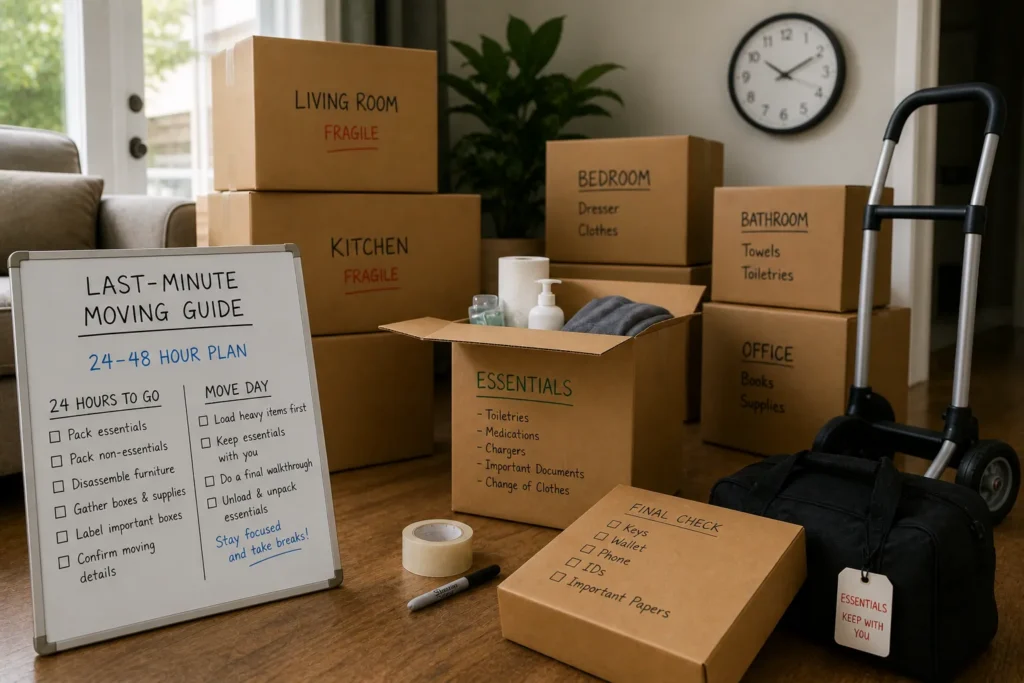
There’s a particular kind of silence that hits when you realize you’re moving. Not sometime next month, not tomorrow. Now. Today. Well, alright, maybe tomorrow morning.
That’s last minute moving, and it doesn’t ask politely. It just shows up, sits down, and starts rearranging your life.
We’ve seen it plenty. People standing in a half-packed room, phone in hand, trying to figure out how to compress a two-month process into about 36 hours. No good. But it’s not impossible either. You just don’t do it the normal way. You do it fast. Decisive. The right way.
When Last-Minute Moves Happen
People like to think moves are planned. Carefully scheduled, neatly organized. Sometimes they are. And sometimes, well, things shift.
Job relocation is a big one. You get the call, the offer, the timeline, and suddenly you’re moving in a hurry whether you like it or not. No slow transition. Just a deadline.
Lease issues sneak up too. Maybe it wasn’t renewed. Maybe something changed. Suddenly you’re looking at an emergency moving situation with very little room to negotiate.
Then there are the unexpected ones — family needs, property sales that close faster than expected, repairs that can’t wait. Life doesn’t always give you a comfortable runway.
And here’s the thing — these situations feel chaotic because they are. But chaos doesn’t mean you can’t impose some structure. You just have to do it quickly. No overthinking.
Step-by-Step Plan for Fast Moving
Alright, so let’s talk about what actually happens next. Because last minute moving is when time behaves differently.
Prioritization
You don’t pack everything at once. You decide what matters most. Documents, valuables, essentials. Those get handled first. Always. You don’t want to be searching for your passport in a box labeled “misc”. That’s not a situation you want to live in.
Packing
You group items logically, you use whatever packing materials you have, and you don’t aim for perfection. You aim for protection and speed. Wrap fragile items enough to survive the trip, not to win an award.
Clothes? Suitcases. Bags. Leave them on hangers if you can and bundle them. It’s not elegant, but it works. Kitchens — pack what you need, box the rest. Don’t sort every drawer. That’s a luxury for slower moves.
Booking movers
This part — well, it can feel like a gamble if you don’t know what you’re doing. You’re looking for same day movers or next-day availability. Not every company can do that. The good ones? They keep some flexibility in their schedule for exactly these situations.
You call, you ask direct questions, you confirm availability. No long back-and-forth. Time is the currency here. If you need a long-distance move then plan everything no less than two weeks before movers show up.
What to Skip and What to Focus On
This is where people struggle. Knowing what not to do. Because in that sort of situation you want to pack everything carefully, but reality says you don’t have time for that.
So you skip deep sorting. You skip organizing every item into perfect categories. You skip overthinking sentimental items — pack them safely, move on. You can revisit them later.
Focus stays on essentials. Clothes you need immediately. Basic kitchen items. Toiletries. Documents. Electronics. That’s your core.
Everything else? Non-essential items can be packed fast, even loosely, as long as they’re protected. You can reorganize after the move. Not during.
There’s also a mental shift here. You accept that this move won’t be perfect. That’s not failure. That’s adaptation. The goal is to get from point A to point B with everything intact. Order can come later.
People often try to clean as they pack in these situations. Don’t. Clean at the end, quickly, efficiently. Mixing cleaning and packing slows everything down.
How to Find Movers Quickly
Now, finding movers on short notice — this is where things can either smooth out or get complicated:
- Availability is the first filter: You need a company that can actually show up within your timeframe. That narrows the field immediately. Not every mover is set up for emergency moving, but you need the ones who are.
- Then reliability: Just because someone is available doesn’t mean they’re the right choice. You’re looking for licensed, insured professionals who can handle the job without adding more chaos.
- A quick scan of reviews helps: Any sort of quick research to confirm they’re trustworthy enough. Look for consistency, not perfection. Every company has a bad review somewhere. It’s the pattern that matters.
- Ask clear questions: What’s included? How long will it take? What’s the cost structure? You don’t need a long consultation. You need straight answers.
And here’s something people overlook — communication. If a company responds quickly, clearly, and professionally, that’s a good sign. In urgent situations, responsiveness matters almost as much as skill.
How Rise Up Moving Can Help Fast
Now, when time is tight, you want a team that’s done this before. Not experimenting. Not figuring it out as they go.
Rise Up Moving handles last minute moving situations regularly. Same-day, next-day, short notice — it’s part of our job. We understand how to move quickly without cutting the wrong corners. There’s a difference between speed and carelessness. We don’t confuse the two.
We bring the equipment, the experience to handle quick packing, transport — all of it. You’re not left guessing what happens next. We guide the process, keep things moving, and adjust as needed.
And maybe most importantly — we show up ready. No delays, no confusion, no half-prepared approach. When you’re dealing with emergency moving, that sort of reliability isn’t just helpful. It’s necessary.
So if you’re staring down a 24–48 hour move, wondering how it’s all supposed to come together — this is where you make it easier on yourself. Reach out and get a free estimate. Fast. Clear. No nonsense.
Ready to get moved? Get a FREE quote now