When people ask how to pack for a move, what they usually mean is, “How do I not lose my mind halfway through boxing up my own life?” Fair question. Happens more than you’d think. Happens more than people admit.
Packing for moving looks simple. One box turns into ten, ten turns into forty, and suddenly you’re standing there holding a vintage violin you forgot you owned, wondering why it feels heavier now than it did five years ago. Time does that. Or maybe it’s just the stress.
Why Proper Packing Matters
Proper packing matters more than people expect. Not a little more. A lot more. It’s the difference between a smooth move and one where something cracks, leaks, or disappears never to be seen again.
Damage
You pack something loosely, or worse, you assume it’ll be fine, and then the truck hits a turn. Just one turn. That’s all it takes. Things shift. Things settle. Gravity, again — always gravity, never takes a day off. Packing efficiently isn’t about being neat, it’s about controlling what happens when you’re not watching.
Time
Improper packing slows everything down. Boxes that are too heavy, too light, too vague — “miscellaneous” is not a category, by the way — it all adds friction. Movers spend more time figuring things out instead of moving forward. And time, well, time costs money. That’s not philosophy, that’s billing.
Cost
Cost creeps in quietly. Extra materials, longer hours, potential damage replacement — it stacks up. People don’t notice it at first, but by the end, they feel it. A well-packed move? It flows. Noticeably smoother.
Efficiency
This part doesn’t get enough credit. When you’re packing boxes with some intention, some structure, everything downstream improves. Loading gets easier. Unloading gets faster. Unpacking becomes less of a scavenger hunt and more of a process. Still a process, still tiring, but at least it makes sense.
Packing Supplies You’ll Need
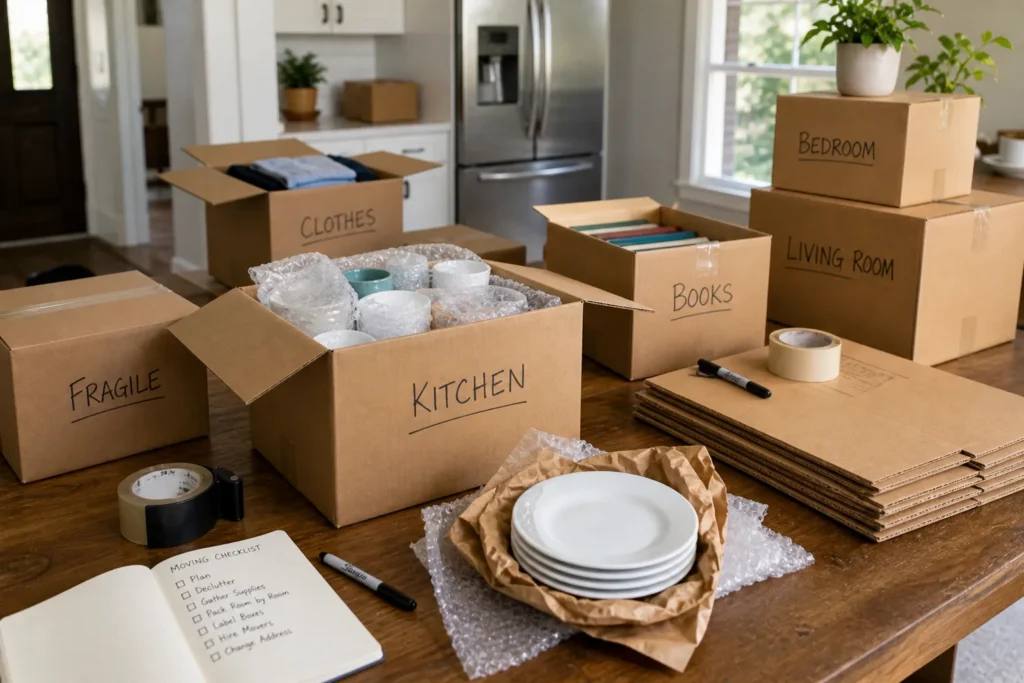
Now, before you even start thinking about wrapping plates or folding clothes, you need your packing supplies. And we’re gonna say this with a little emphasis — don’t cheap out here. Not wildly, not irresponsibly, just don’t cut corners where it counts.
- Boxes, first off: Different sizes, not just one type. Small ones for heavy items, big ones for lighter things. You put books in a large box, you’ll regret it halfway to the truck. That’s just physics reminding you who’s in charge.
- Tape: Strong, reliable, the kind that doesn’t peel off when it feels like it. You’ll use more than you think. Everybody does.
- Bubble wrap, or something like it: Cushioning matters. You’re not just filling space, you’re creating protection. Porcelain, glass, anything fragile — it needs that buffer. Towels can help too, sure, but they don’t replace proper wrap.
- Labels: Clear, visible, consistent. Room names, maybe a short description. Future you will thank present you, even if present you is tired and slightly annoyed at the whole process.
Room-by-Room Packing Guide
Now that’s where things start to feel manageable. Or at least less chaotic. You take one space, deal with it, move on. Sounds simple. It isn’t always, but it helps.
Kitchen
The kitchen is where time goes to stretch out. So many small items, so many fragile ones. Plates stacked with padding, glasses wrapped individually. And the random drawer full of things nobody remembers buying. Take it slow here. Rushing a kitchen is how things break.
Bedroom
Bedrooms feel easier at first. Clothes, linens, personal items. Then you hit the closet. Then the dresser. Then that one box under the bed. It adds up. Fold where you can, box where you must. Keep similar items together, even if it feels repetitive. It pays off later.
Bathroom
Bathrooms are quick, usually. Smaller items, fewer surprises. Just watch for liquids. Seal them properly or you’ll open a box later and wonder why everything smells like laundry detergent. Not the worst outcome, but not ideal either.
Living room
Large items, also a mix of electronics, decor, books, things that don’t quite belong anywhere else. Wrap electronics carefully. Secure cables. And don’t just toss remotes into random boxes. That’s a mistake you only make once.
Packing Tips from Professional Movers
Weight distribution is the first thing. Heavy items go in small boxes. Always. Lighter items can fill the larger ones. You balance the load, you protect your back, and you make stacking easier. It’s not complicated, but people skip it. Then regret follows.
Organization matters more than speed. Packing efficiently isn’t about finishing quickly, it’s about finishing correctly. A well-packed box saves time later. A rushed box creates confusion. And confusion spreads.
Labeling comes up twice because it matters twice as much as people think. Clear labels, consistent placement, readable writing. You’re building a system, even if it feels informal.
And don’t overfill boxes. Leave a little space. Not empty space, but breathing room. Enough to cushion, not enough to shift. There’s a balance there. Hard to explain, easier to feel once you get it.
Common Packing Mistakes to Avoid
People overpack boxes, thinking they’re saving time. They’re not. They’re creating problems. Heavy boxes slow everything down and increase the risk of damage or injury.
Then there’s under-labeling. Or vague labeling. Or no labeling at all. It all leads to the same outcome — confusion and regret. Usually when you’re tired and less patient.
Skipping protection is another one. Wrapping takes time, yes, but not wrapping costs more time when something breaks. It’s a trade-off, and the smart move is clear.
Mixing unrelated items — kitchen with bedroom, bathroom with living room — creates chaos during unpacking. Keep things grouped. It works.
And rushing. That’s the big one. Packing too quickly, trying to finish in one push. It leads to all the other mistakes. Slow down just enough to stay organized.
Need Help? Hire Professional Packers
Sometimes, the best way to handle packing for moving is not to handle it yourself. Not entirely, anyway.
Professional packers exist for a reason. They bring the packing supplies, the system, the experience. They know how to pack for a move in a way that protects your belongings and keeps the process moving forward.
Rise Up Moving offers that kind of support. Not pushy, not over the top, just practical help when you need it. You can still stay involved, still guide the process, but you don’t have to carry all of it.
And that’s the thing. Moving doesn’t have to be a solo effort. It can be shared, structured, managed. A little less chaotic. A little more controlled. Because at the end of the day, this isn’t just about packing. It’s about getting from one place to another without losing pieces of the journey along the way. Literally and otherwise.
Ready to get moved? Get a FREE quote now