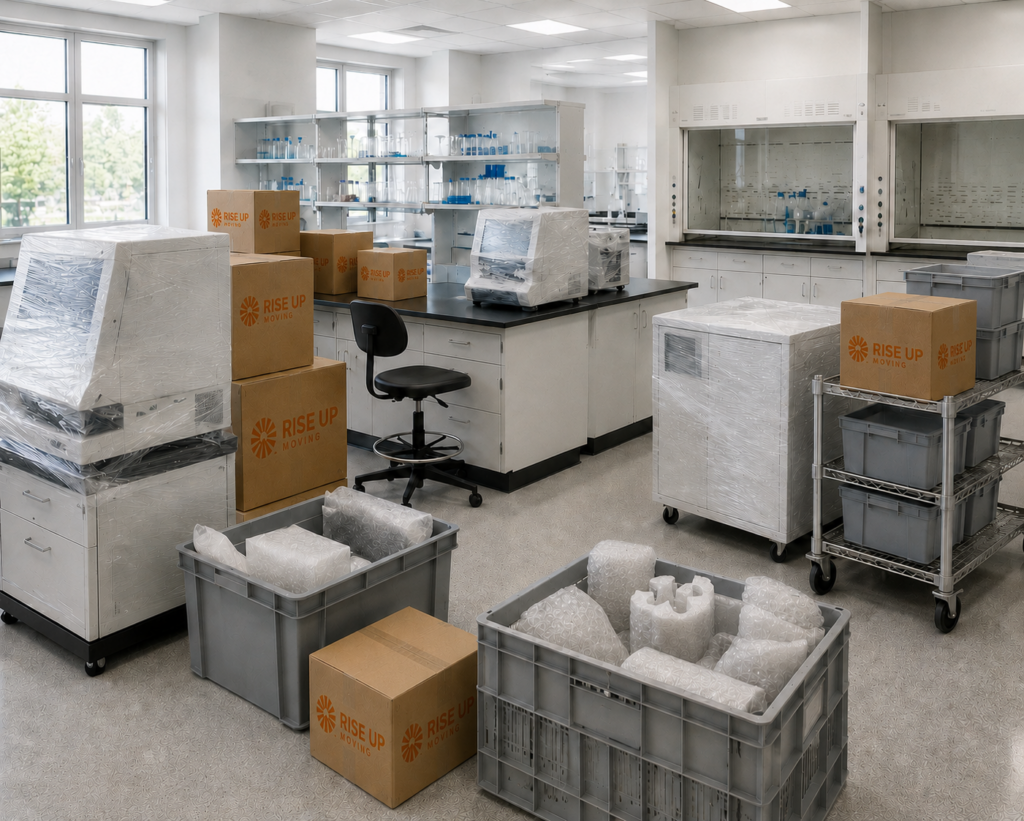
Most moves are measured in boxes. Laboratory moves are measured in variables. Some are visible. Centrifuges. Microscopes. Freezers large enough to make ordinary refrigerators feel a little self-conscious. Analytical instruments covered with warning labels that quietly suggest expensive things happen if they’re handled carelessly.
Other variables never appear in photographs. Calibration. Validation. Environmental conditions. Chain of custody. Research continuity. Years of collected data that depend on one instrument arriving exactly as it left.
A laboratory doesn’t simply contain equipment — it contains confidence. Confidence that tomorrow’s experiment can be compared with yesterday’s. Confidence that measurements remain trustworthy. Confidence that months — or sometimes years — of work won’t quietly unravel because someone underestimated what looked like just another machine. That’s why lab equipment moving occupies an entirely different category from traditional commercial relocation.
The truck may look familiar. Almost everything else changes. Moving a research facility isn’t about transporting expensive hardware from one address to another. It’s about preserving precision while the entire environment changes around it.
What Makes Laboratory Equipment Uniquely Difficult and Expensive to Move
People unfamiliar with laboratories often assume the biggest challenge is cost. Laboratory equipment certainly isn’t inexpensive. Some instruments cost more than houses. Others cost less but become essentially irreplaceable because they’re configured in very specific ways, integrated into larger systems, or tied to research projects that have evolved over years.
Replacement isn’t always the issue. Recreating the exact operating environment often is. That’s a much stranger problem.
Scientific Equipment Doesn’t Like Being Disturbed
Most office furniture expects to be moved eventually. Desks have accepted their fate. Laboratory equipment often behaves as though relocation is an unfortunate misunderstanding.
Highly sensitive instruments become accustomed to vibration levels, electrical conditions, humidity, room temperature, airflow, and stable positioning. Change too many of those variables at once and the equipment may continue functioning differently.
Sometimes only slightly. Sometimes enough to affect results. Science tends to notice small differences.
Weight Is the Least Interesting Problem
People naturally focus on heavy equipment. Large incubators. Ultra-low temperature freezers. Massive imaging systems. Industrial centrifuges. They certainly require specialized handling. Yet weight rarely represents the greatest challenge. Balance does. Fragility does. Internal components do.
Many scientific instruments contain delicate assemblies that tolerate normal operation beautifully while responding rather poorly to sudden impacts, uneven lifting, or transportation without proper stabilization.
A microscope may appear solid. Internally, it resembles careful engineering having an ongoing conversation with gravity. Interrupt that conversation carelessly and repairs become unexpectedly educational.
Every Instrument Has Its Own Personality
Not literally but some researchers might disagree after spending enough late evenings troubleshooting them.
Different equipment asks for different treatment. One analyzer requires components removed before transport. Another travels best fully assembled. Certain instruments need internal locks engaged. Others must remain upright at all times. Some tolerate vibration. Others seem personally offended by it.
Trying to move every instrument using identical procedures makes about as much sense as packing every book, computer, and coffee mug into the same box because technically they’re all objects.
Accuracy lives in the details. Laboratories know this. Professional movers should too.
Research Doesn’t Pause Just Because the Building Changes
Laboratories rarely operate in isolation. Equipment supports experiments. Experiments support projects. Projects support grants. Grants support researchers. Researchers support institutions.
One delayed instrument can quietly influence dozens of schedules stretching months into the future. The relocation isn’t simply interrupting logistics — it may be interrupting discovery.
Sometimes delaying access to a single instrument postpones publications, regulatory submissions, collaborative studies, or manufacturing timelines.
The equipment travels once. Its consequences travel much farther.
The Environment Matters Almost as Much as the Equipment
Imagine carefully transporting a highly sensitive instrument only to install it in a room that hasn’t stabilized environmentally. Temperature fluctuates. Humidity shifts. Power systems remain under testing. The equipment survives the move. The laboratory still can’t use it.
Professional laboratory relocation services understand that relocation doesn’t end when the truck unloads. Arrival and operational readiness are separated by an important stretch of work. Sometimes that stretch is short. Sometimes it isn’t. Planning acknowledges both possibilities.
Pre-Move Documentation, Calibration, and Equipment-Specific Handling Protocols
Documentation comes first. Always.
People occasionally feel impatient during this stage because very little appears to be happening. Clipboards. Photographs. Equipment inventories. Serial numbers. Configuration records. Connection diagrams. Notes. So many notes. Progress seems slow. In reality, this may be the fastest part of the entire project because careful documentation quietly prevents countless hours of confusion later.
Memory has confidence. Documentation has evidence. Those aren’t interchangeable.
Every Cable Has a Story
Walk behind a sophisticated laboratory instrument. It’s astonishing. Power cables. Network connections. Sensor lines. Gas supplies. Cooling systems. Peripheral devices. Some cables appear identical while performing entirely unrelated functions. Removing everything without recording the original configuration is a little like taking apart a mechanical watch because you’re reasonably certain it will explain itself afterward.
Occasionally life rewards optimism. Usually not.
Detailed labeling feels excessive. Right until reinstallation begins. Then suddenly everyone develops deep appreciation for labels.
Calibration Doesn’t End Before the Move
Many people think about calibration as something performed after relocation. Not quite.
Before disconnecting equipment, laboratories often document current operating conditions, performance status, calibration records, and baseline measurements. Why? Because comparison matters.
If something changes unexpectedly after transport, teams need reliable reference points rather than educated guesses. Science has always preferred measurements over memories. For good reason.
Disassembly Deserves Patience
Some laboratory systems come apart in clearly defined sections. Others don’t. Or rather, they do, but only according to manufacturer procedures that were developed after many engineers spent many years learning exactly which components should never experience unnecessary stress.
Professional teams resist improvisation. That sounds simple. It’s surprisingly difficult when schedules become tight. The temptation to save ten minutes occasionally creates three weeks of repair work.
Laboratories have learned this lesson repeatedly. Experienced movers have too.
Protection Changes From One Instrument to the Next
Moving blankets remain useful. They’re simply not the whole story. Custom crating. Shock protection. Moisture barriers. Anti-static materials. Foam engineered for specific pressure points. Transport locks. Protective covers. Humidity control where necessary. Sometimes climate-controlled vehicles. Sometimes vibration monitoring. The interesting thing about moving scientific equipment is that two instruments standing beside each other may travel using entirely different protective systems.
Uniformity feels efficient. Specialization usually proves safer.
The Smallest Components Sometimes Matter Most
Large laboratory equipment attracts attention. Small accessories quietly determine whether that equipment functions afterward. Objectives. Optical filters. Calibration weights. Detector modules. Precision probes. Specialized sample holders. Custom adapters. Tiny components disappear remarkably well if they aren’t tracked carefully. Unfortunately, they’re often the hardest items to replace.
Entire instruments occasionally sit unused because one specialized accessory remains somewhere inside an unlabeled storage container. A surprisingly expensive game of hide-and-seek. Nobody enjoys it.
Reinstallation Is More Than Reassembly
There’s a subtle difference. Furniture gets assembled — scientific equipment gets commissioned. Power systems require verification, environmental conditions need confirmation. Software connections must function. Performance testing often follows. Calibration checks, manufacturer procedures where applicable, also internal validation. Sometimes external certification. Only then does the equipment truly return to service.
The move isn’t complete when everything looks correct — it’s complete when everything measures correctly. Scientists tend to care about that distinction. Quite a lot.
How to Choose a Moving Company With Actual Lab Relocation Experience
Expensive equipment exists everywhere. Luxury furniture is expensive. Medical imaging systems are expensive. Industrial machinery is expensive. Laboratory instruments introduce a completely different collection of challenges.
Specificity matters.
Experience Leaves Different Clues
Companies experienced in lab equipment moving tend to speak a slightly different language. They ask about calibration schedules. Instrument manufacturers. Utility connections. Environmental controls. Research continuity. Validation requirements. Downtime limitations. They rarely begin by discussing truck sizes.
The trucks usually take care of themselves. Planning occupies far more conversation. That’s generally encouraging.
They Should Welcome Technical Conversations
Researchers know their equipment. Very well. Sometimes astonishingly well. A professional moving team shouldn’t become uncomfortable when laboratory managers begin discussing vibration sensitivity, manufacturer recommendations, specialized lifting points, or controlled shutdown procedures.
Quite the opposite since those conversations improve the relocation.
Good movers listen. Excellent movers ask additional questions. Neither group pretends to know the laboratory better than the scientists working inside it.
Collaboration consistently outperforms assumptions.
Manufacturer Coordination Isn’t Unusual
Certain laboratory instruments require manufacturer representatives or certified service engineers during disconnection, transportation, or recommissioning. Experienced laboratory relocation services understand this. They coordinate. Schedules become shared. Responsibilities become clear.
Nobody assumes — assumptions have a peculiar habit of becoming invoices. Planning remains a cheaper option.
References Should Sound Familiar
Request references from organizations resembling your own.
Universities. Research institutes. Biotechnology companies. Pharmaceutical laboratories. Environmental testing facilities. Quality control laboratories. Materials science centers. Every laboratory operates differently. Still, familiar environments reveal familiar challenges.
A company comfortable relocating office furniture may perform excellent work. That experience doesn’t automatically translate into highly specialized scientific environments.
Different expertise grows from different repetition.
Local Experience Matters
Organizations searching “lab movers San Francisco” online often focus on technical capability first. As they should. Yet local familiarity introduces another layer of value. Research campuses. University facilities. Downtown laboratory buildings. Biotechnology corridors. Loading restrictions. Building management procedures. Traffic patterns. Permitting. Equipment access routes. None of these replace technical knowledge — they simply remove additional uncertainty from an already complex project.
Small advantages accumulate.
The Goal Isn’t Just Safe Transportation
People naturally describe laboratory relocation as moving equipment. That’s understandable. It’s also incomplete.
The real objective is preserving research continuity. Preserving confidence. Preserving reproducibility. Protecting years of careful work that happen to depend on remarkably sophisticated machines behaving tomorrow exactly as they behaved yesterday. That’s an unusual responsibility. Perhaps that’s why successful laboratory moves often appear strangely uneventful from the outside.
Trucks arrive. Equipment disappears. Equipment reappears. Researchers gradually return to their benches. Experiments resume. The first measurements match expectations. No dramatic stories emerge. No emergency service calls dominate the following weeks. Nobody remembers the exact morning when the old laboratory stopped feeling current and the new one quietly became the place where work had apparently always belonged.
Instead, conversations return to what laboratories were built for in the first place. Questions. Data. Unexpected results. Occasionally exciting discoveries. And, every so often, one researcher staring thoughtfully at a graph that refuses to behave, blissfully unaware that only a few weeks earlier an entire facility had been carefully dismantled, transported across the city, rebuilt, recalibrated, verified, and returned to operation without asking science itself to slow down.
That quiet continuity — not merely the successful transportation of equipment — is what defines an exceptional laboratory relocation.