Wrap furniture in layers, and match the layer that touches the piece to the surface underneath. Soft, dry padding goes against the furniture. Stretch wrap goes on the outside to hold the padding in place. Nothing sticky or airtight should sit directly on wood, leather or fabric for long. Glass travels upright, corners get extra protection, and every wrapped piece should be loaded so it cannot shift. Almost every damage story in moving, from a peeled finish to a cracked tabletop, comes from breaking one of those rules.
Most guides list the same supplies and tell you to wrap everything the same way. That is where the damage starts, because wood, fabric, leather, glass and mattresses react differently to plastic, tape and pressure. This guide goes piece by piece, explains why each method works and flags the points where professional sources disagree, so you can choose with your eyes open.
Quick reference by piece
| Piece |
Layer against the surface |
Outer layer |
Avoid |
| Wood furniture |
Dry moving blanket |
Stretch wrap over the blanket |
Plastic or tape directly on the finish |
| Antiques |
Acid free paper, then blankets |
Stretch wrap, loose enough for airflow |
Wrapping while damp |
| Fabric sofas and chairs |
Cushions removed, surface vacuumed, blanket or breathable cover |
Stretch wrap to hold the cover |
Airtight sealing for long periods |
| Leather |
Breathable fabric or dry blanket |
Plastic only as a securing layer |
Tape touching the leather |
| Glass tops and mirrors |
Paper, cardboard, bubble wrap |
Tape on the cardboard, not the glass |
Laying flat, stacking weight on top |
| Dressers and cabinets |
Blanket on corners and top |
Stretch wrap around the body to keep drawers shut |
Heavy drawers held closed by plastic alone |
| Headboards and frames |
Blanket and cardboard |
Stretch wrap, extra layers at corners |
Bare corners |
| Mattresses |
Mattress bag |
Tape across the bag |
Car roof transport, or letting the bag get wet |
Before you wrap anything
Clean the piece
Dust and grit trapped under padding act like sandpaper over a long drive. Wipe wood and glass with a soft cloth and a gentle cleaner, and vacuum upholstery. Let everything dry completely first, because wrapping a damp piece traps moisture against it.
Take it apart
Remove legs, cushions, shelves, mirrors and anything else that detaches. Smaller components are easier to protect and easier to carry, and detaching them removes the parts most likely to snap. Put screws, bolts and brackets for each piece in a labeled bag and tape the bag to the piece. If assembly is not obvious, photograph it before you start.
Empty what you can
Dressers and cabinets are heavier with contents, and loose items shift inside. Remove anything breakable, and anything heavy enough to strain a drawer. If you want to leave light items in a dresser, ask the crew first, since policies differ between companies.
Plan for the extra size
Padding adds a few inches to every dimension. Measure doorways and stairwells again with the wrapped size in mind, because a piece that fit through the door unwrapped may not fit once it is padded.
The layers and what each one does
Moving blankets or furniture pads absorb impact and protect surfaces from scratches. They are the layer that should touch your furniture.
Stretch wrap holds blankets in place and keeps drawers and doors from opening. It works because it clings to itself, so it does not need tape. Its job is to be the outer layer.
Packing paper protects fine surfaces and fills gaps. Acid free paper is the careful choice for antiques, since it avoids reactions between the finish and plastic or dyes.
Bubble wrap and cardboard protect glass, mirrors and fragile decorative parts. Cardboard also shields sharp edges and corners.
Corner protectors matter more than they look. One professional guide notes that most impact damage happens at corners, and corners are where blankets slip first.
Painter’s tape is the tape for delicate surfaces. Standard packing tape on a finished surface can strip lacquer or leave residue, and tape on bare glass leaves a sticky mess.
Straps and tie downs hold heavy doors and drawers, and secure the load in the truck.
Wood furniture
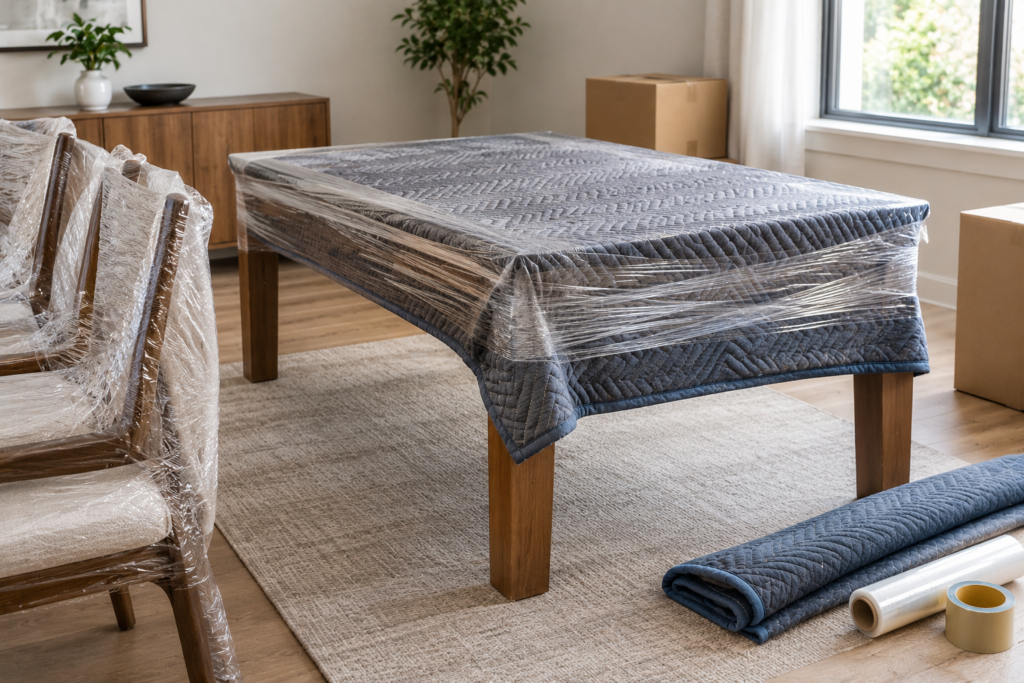
Cover the piece fully in moving blankets, with extra padding at corners and legs, then secure the blankets with stretch wrap. The reason is chemical as well as physical: plastic or tape touching wood can peel the finish, and plastic can trap condensation against it. Keep the plastic on the outside of the blanket, not against the wood.
Do not use tape on the finish itself. If drawers need to stay closed, keep them shut with wrap over the blanket, not with tape on the surface. For antiques and fine pieces, start with acid free paper, add blankets, and apply stretch wrap loosely enough to leave some airflow.
Tables are the most common problem piece, because legs and corners take the hits. Remove legs when you can, wrap each leg separately, and protect the top with a blanket and cardboard. If you are packing a dining table specifically, our guide to packing a dining table covers the disassembly order and hardware handling in detail.
Upholstered sofas and chairs
Remove cushions and legs where possible and bundle the cushions separately. Vacuum the whole piece first, since trapped dirt scuffs fabric.
Here the professional sources disagree, and it is worth knowing why. Some advise against putting plastic against upholstery at all, recommending moving blankets or breathable covers, with stretch wrap only to hold them in place, because plastic can trap moisture. Another guide says stretch wrap can go directly on fabric because it does not trap condensation and is wrapped from the bottom up. The disagreement mostly comes down to time and weather. For a short local move on a dry day, a cover or blanket under the wrap is the safe middle path. For a long trip, a humid season or a stay in storage, avoid sealing fabric in plastic.
Whichever you choose, wrap from the bottom up so the film overlaps like shingles, and do not pull it so tight that it crushes arms or distorts cushioning. Over tightening plastic or straps can damage upholstery and the frame.
Leather
Leather needs the most care with plastic. Use dry moving blankets or pads against the leather, with a breathable fabric layer between the leather and any plastic. Keep tape off the surface, because tape can strip color or leave residue. Conditioning the leather before the move can help prevent cracking. If you use stretch wrap, use it only to hold the blankets in place, never against the leather.
Glass, mirrors and glass tabletops
Glass is the least forgiving material, and the rule is simple: protect it with layers, keep it vertical, and keep weight off it.
- Remove the glass if you can. A glass top that comes off the base is safer on its own.
- Layer. Packing paper first, then bubble wrap, then rigid cardboard, taped at the edges of the cardboard.
- Tempered glass. Wrap the entire piece in heavy duty cushioning, sandwich it between two layers of cardboard and seal it completely. Chipped edges can make tempered glass shatter, so edges deserve extra padding.
- Glass that cannot be removed. If you tape it, use painter’s tape in a crisscross pattern to stabilize it. For glass cabinets, fill the space behind the glass with paper or inflatable pillows so the glass does not flex inward.
- Transport upright. Glass and mirrors should never lie flat in a truck.
- Nothing on top. Do not stack heavy items on glass.
Marble tops are not covered in detail by the sources we reviewed. If you are moving one, treat it with the same caution as glass, ask the crew how they handle it, and check with the manufacturer if it is a fitted top.
Dressers, cabinets and drawers
Wrap stretch film around the body of the piece to keep drawers closed, protect the corners with blankets, and secure the blankets with the film. Remove attached mirrors and pack them separately.
Heavy drawers and doors need more than plastic. Use twine or straps for anything that could push the film open. Stretch wrap is not strong enough to hold a heavy drawer under the stress of a drive.
A wrapped dresser also has a second role in the truck. Wrapped dressers can act as walls inside a load, with the heaviest placed against the side walls and lighter items on top. That is one reason crews like to load dressers early.
Headboards, bed frames and bookshelves
Headboards need blankets and cardboard for stiffness, secured with stretch wrap, with extra layers at the corners. Fragile materials like rattan need a layer of bubble wrap over the first wrap. Bed frames should be disassembled, with side rails, slats and hardware bundled and labeled together.
Bookshelves are best emptied, with shelves removed and wrapped separately, and the frame padded at the corners.
Mattresses and box springs
Use a mattress bag sized for the mattress. Slip the mattress in, seal the opening, fold and tape the edges, then tape across the top, middle and bottom in both directions in a crisscross pattern. Box springs are wrapped the same way. Patch any tears before moving the mattress outdoors, and keep it dry, because a soaked mattress can take up to a week to dry.
How a mattress travels depends on its type.
| Type |
How it travels |
Notes |
| Coil or spring |
On its side edge, strapped to a wall of the truck |
Add cardboard front and back for stiffness if it is floppy |
| Memory foam |
Flat, loaded late and on top of other items |
Use a breathable bag or cloth sheet, since heavy plastic traps moisture |
Memory foam can sometimes be folded if it is less than 11 inches thick, but not for more than an hour or two, and coil or innerspring mattresses should never be folded. For specialty mattresses, check the manufacturer’s guidance. And if a mattress is more than about eight years old, it may be nearing the end of its useful life, so weigh moving it against replacing it.
Two walkthroughs
The principles above are easier to hold onto with a concrete sequence, so here are the two pieces people wrap most often.
A sofa, start to finish
- Clear the room around it. You need space to walk around the piece with a roll of wrap.
- Remove what comes off. Take off cushions and legs, and bundle them separately. Put leg hardware in a labeled bag.
- Vacuum every surface, including the seams and under the cushions, so no grit stays trapped under the padding.
- Add the soft layer. A breathable sofa cover or a moving blanket goes over the fabric. On a long trip or in humid weather, keep this layer in place even if you are tempted to skip it.
- Wrap from the bottom up. Start at the base and work upward in overlapping passes, like shingles, so the film holds the cover in place. Secure the end with tape on the film itself, never on the sofa.
- Pad the corners and arms. Add a folded blanket or cardboard at the corners, since they take the knocks.
- Bag and label the cushions and tape the hardware bag to the frame.
- Check the fit. Remeasure the wrapped piece against the doorway before the crew arrives.
A dresser, start to finish
- Remove the breakables. Take off any attached mirror and pack it separately, and empty anything heavy or fragile from the drawers.
- Decide about the drawers. If the crew accepts light contents left inside, keep them light. If a drawer is heavy, take the contents out.
- Pad the top and corners. Lay a blanket over the top and protect the corners with cardboard or protectors.
- Wrap the body. Run stretch film around the whole piece so the drawers cannot slide open. The film should go over the blanket, not against a bare finish.
- Add straps for heavy drawers or doors. Stretch wrap alone will not hold a heavy drawer in place.
- Label it with its destination room and mark the front, so the crew can place it without asking.
Neither sequence takes long once the supplies are laid out. The time goes into the preparation: cleaning, emptying and disassembling. That is also where most avoidable damage is prevented.
How the load changes the way you wrap
Wrapping does not end at the door. The truck changes what the wrap has to do.
- If it can move by hand, it will move in transit. Every piece should be loaded so it cannot be pushed around by hand once secured.
- Stack nothing on fragile surfaces. A wrapped dresser can carry weight on top, but a glass tabletop cannot.
- Keep wrapped pieces upright and in position. Appliances and furniture stand against the walls, and mattresses stand along the sides.
- Weather matters. Wrap can temporarily protect from rain during loading and unloading, but long periods in extreme heat or humidity, especially in storage, can cause trouble.
Rise Up crews bring blankets, stretch wrap and tape on every move, so a household does not need to buy furniture padding for a job the crew will do. Our packing services page explains what the crew can handle if you would rather not wrap anything yourself, and our guide to moving furniture properly covers the do’s and don’ts of carrying it. For very large or awkward pieces, see our advice on moving heavy furniture.
Supplies checklist
| Item |
Use |
| Moving blankets |
First layer on wood, leather and most pieces |
| Stretch wrap |
Outer layer, drawers and doors |
| Packing paper, acid free for antiques |
Fine surfaces and gaps |
| Bubble wrap |
Glass and fragile parts |
| Corrugated cardboard |
Edges, corners, glass sandwiches |
| Corner protectors |
Corners of every piece |
| Painter’s tape |
Delicate surfaces and glass |
| Packing tape |
Securing cardboard and bags, never on finished surfaces |
| Moving straps or twine |
Heavy drawers and doors |
| Mattress bags |
Mattresses and box springs |
| Sofa covers |
Dust and dirt on upholstery |
| Labeled bags |
Hardware for disassembled pieces |
Edge cases
A piece that will sit in storage. Avoid sealing wood, leather or fabric in plastic for long periods, and avoid wrapping in extreme heat or humidity. Use breathable covers and blankets for stored furniture.
Antiques and heirlooms. Use acid free paper first, then blankets, and leave airflow. Ask the crew how they handle fragile finishes before the day.
A very rainy move. Wrap helps keep moisture off during loading and unloading, but dry the piece completely first and keep a layer of cloth between plastic and surface.
A piece that is too large to wrap normally. Sectionals and large armoires may need disassembly or special handling. Mention them when you request an estimate.
A piece you are not sure about. If you do not know the finish, assume it is delicate. Blanket first, plastic on the outside, no tape on the surface.
Mistakes to avoid
- Wrapping wood or leather directly in plastic.
- Putting packing tape on a finished surface.
- Taping bare glass.
- Wrapping a dirty or damp piece.
- Laying glass or mirrors flat in the truck.
- Skipping corner protection.
- Leaving a heavy drawer closed with only stretch wrap.
- Forgetting that padding adds inches when measuring doorways.