A laboratory relocation is a controlled transfer of function, and the move itself is the shortest part of it. The weeks before the truck arrives are spent on inventories, decontamination, regulatory notifications and sign-offs. The weeks after are spent on recertification, calibration and getting the science running again. A lab that treats the project as a trucking job usually discovers, late, that its biosafety cabinet cannot be used until it has been certified, or that a freezer full of samples has no home for the six hours between buildings.
This guide walks through the stages of a lab move in the order they happen: assessment, safety clearance, packing and transport, reinstallation and restart. It also shows who is responsible for each stage, because a lab move involves at least four parties and they rarely share the same vocabulary.
Who does what in a lab relocation
Lab moves go wrong at the handoffs between teams. Name an owner for every row below before the project is announced to the building.
| Party |
Responsibility |
| Principal investigator or lab manager |
Inventory, decisions on what moves and what is disposed of, restart priorities |
| Environmental health and safety office |
Hazard clearance, waste disposal, regulatory notifications, move assessment and close-out inspection |
| Facilities |
Utilities at the new site, hood and cabinet connections, floor loading, access routes |
| Equipment manufacturers and service vendors |
Instrument shutdown, disassembly, transport instructions, reinstallation, recalibration |
| Moving company |
Physical transfer: packing, loading, controlled transport, placement according to the layout |
| Certified industrial hygienist or equivalent |
Independent sign-off on decontamination, where the project requires it |
The division is important. Hazard clearance belongs to the lab and its safety office. A moving company should receive equipment that has already been cleared, with documentation attached, and should not be asked to judge whether an instrument is safe to handle. If a university or institution runs the move, its own safety procedures govern, and those procedures are stricter than any general checklist.
Stage 1: Assessment and planning
Start with the inventory, because every other decision depends on it.
Build an inventory that movers and safety staff can both use
For every item, record what it is, where it is, how heavy it is, and what it requires. Group the items so the plan can treat them differently:
| Category |
Examples |
Key planning question |
| Calibration-sensitive instruments |
Balances, spectrometers, microscopes, analyzers |
Does the manufacturer require its own technician to disassemble, pack or reinstall? |
| Heavy fixed equipment |
Fume hoods, biosafety cabinets, autoclaves, large centrifuges |
Who disconnects it, who moves it, and what certification is needed afterward? |
| Cold storage |
Refrigerators, freezers, cold rooms |
Where do the contents go during the move, and for how long? |
| Chemicals |
Reagents, solvents, compressed gas cylinders |
What moves, what is returned to a supplier, what is disposed of? |
| Biological materials |
Cultures, samples, waste |
What approvals apply, and what containment is needed in transit? |
| General furniture and consumables |
Benches, shelving, storage, office items |
What can be handled by a standard commercial moving crew? |
Walk the lab with the people who use it. Interview the researchers, not only the manager. They know which instrument drifts, which cabinet is used for which agent and which drawer holds something nobody has labeled.
Know your obligations before you set the date
- Notify your safety office as soon as the date is known. University programs commonly require early notice, and non-compliance can delay the schedule and add cost.
- Check the lease or move-out terms. Landlords may require a decommissioning report, and the obligations can change the budget.
- Identify permits and licenses with lead times. Radioactive materials, controlled substances and biological agent registrations all take time to move or amend.
- Review the standard for decommissioning. University safety programs often reference ANSI/ASSE Z9.11, the laboratory decommissioning standard, which organizes the work into assessment, decontamination and documentation. Ask your safety office which edition and procedure applies to your institution.
Expect surprises
Labs that have operated for years accumulate unlabeled bottles, expired reagents and equipment nobody remembers using. Plan for unanticipated waste and set aside budget and time for it. University procedures are blunt on one point: unidentified chemicals cannot simply be handed over, and identifying them can mean laboratory testing at the lab’s expense.
Stage 2: Clearance and decontamination
This is the stage that decides whether the move can start, and it belongs to the lab and its safety office.
Chemicals
- Identify and segregate every chemical by compatibility and hazard class.
- Store waste in containers suitable for transport and disposal.
- Confirm whether radioactive materials or heated perchloric acid were ever used in a fume hood and that no contamination remains before the hood is disturbed.
- Handle compressed gas cylinders through trained personnel. Typical procedure: label each cylinder, remove the regulator and fit a valve cap before transport, or return it to the supplier.
- Never transport hazardous materials alone, and use protective equipment appropriate to the material.
Biological materials and equipment
- Decontaminate biohazardous materials and waste, and place sharps in approved containers. No hazardous waste should remain in the vacated lab.
- Wipe surfaces of equipment used with biological materials with an appropriate disinfectant. One university procedure specifies a 1:10 bleach solution. Use whatever your safety office specifies for your organisms and materials.
- Decontaminate refrigerators, freezers and incubators before they move. If contamination cannot be removed, label the unit with the biohazard symbol and keep it contained throughout the move. No contaminated equipment should be left behind in the old space.
- Notify the institutional biosafety committee where required, and complete registrations before relocating biological materials, so approvals exist before anything is transported.
- Inoperable freezers and refrigerators may need refrigerant removal by a qualified party before they can be moved or disposed of.
Biosafety cabinets and fume hoods
Biosafety cabinets need their own plan. They are heavy, sometimes more than 600 pounds, and should be moved only by a crew with the right equipment. University guidance commonly requires that a cabinet be gas-decontaminated by a field certifier when it moves to a different lab after use with higher-risk agents, when its filter history is incomplete, or when its filters are being replaced. The certifier’s decontamination report is typically posted on the cabinet, and a cabinet without it should not be moved. After any move to a new location, the cabinet must be recertified before it is used again. Tell the moving company about the cabinet early, because it determines equipment and crew size.
Fume hoods have a similar logic. Record equipment tag numbers, confirm that no contamination remains, and plan the disconnection from ventilation with facilities.
Documentation
A strong close-out record is complete enough that the work could be independently reproduced. It typically includes:
- The methods used to assess and clean each area
- A list of chemicals and hazards present during operation
- Where waste was held
- Before-and-after photographs confirming decontaminated areas
- A signed statement of acceptable risk from a qualified professional, where the project calls for one
Keep this file. It protects the lab at move-out and answers questions months later.
Stage 3: Packing, instruments and cold storage
Instruments
Each instrument has its own requirements, and the manufacturer’s instructions outrank general advice.
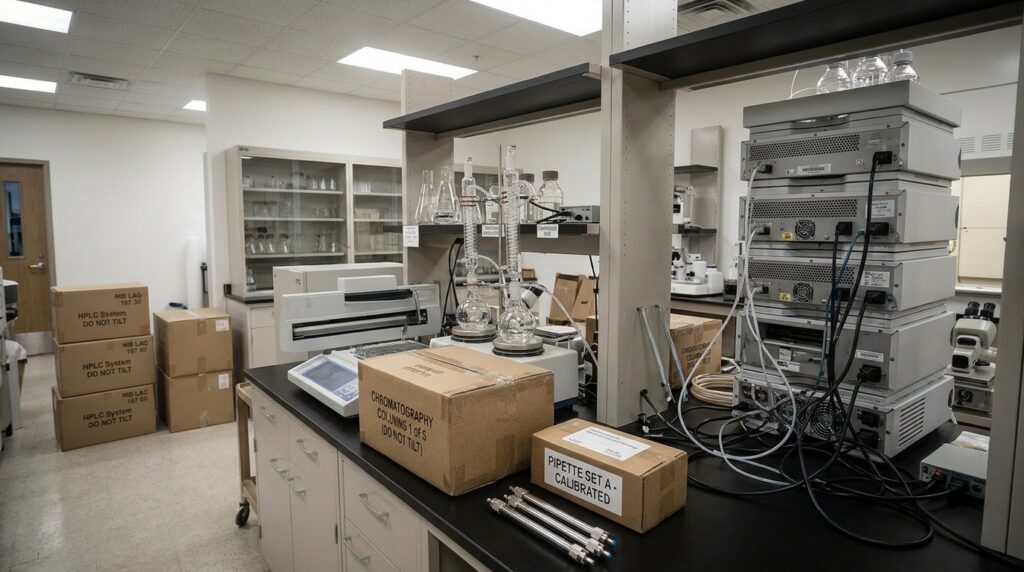
- Ask the manufacturer first. Many analytical instruments need a service engineer to lock components, drain fluids or remove sensitive modules before transport. Some manufacturers will not warrant an instrument that was moved without their involvement.
- Photograph and label connections before disassembly, including cables, tubing and ports.
- Pack small components separately, labeled to the instrument, with the associated software and configuration files backed up.
- Match protection to the instrument. Vibration-sensitive equipment needs different cushioning than a heavy fixed unit.
- Plan reinstallation before the move. The destination layout should show where each instrument goes, where its power and gas supplies are and who connects them.
Cold storage and samples
Samples with temperature requirements are the highest-stakes cargo in the lab. Treat them as a separate project inside the project.
- List every item in each freezer and refrigerator and decide what moves, what is transferred to another group and what is discarded.
- Arrange temporary storage or temperature-controlled transport with a documented handoff, so there is never a moment when nobody is responsible for the contents.
- Check regulations that apply to the shipment. Dry ice, for example, is regulated as a hazardous material in transport, so confirm packaging and labeling rules with your safety office before relying on it.
- Use secondary containment, such as a sealed tub for bottles, and move samples by cart without stacking, using indoor routes where possible instead of busy public corridors.
- Plan the receiving end first: powered, verified and cold before the first sample arrives.
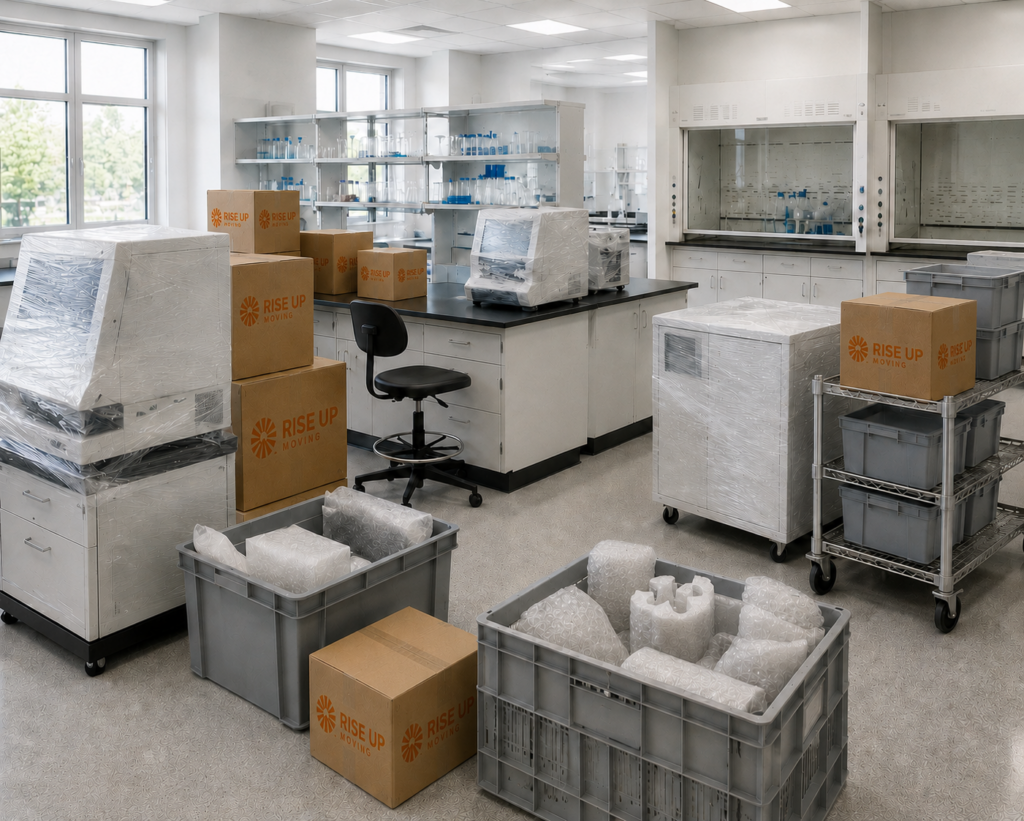
Rise Up Moving’s lab moving service lists temperature-controlled transport and controlled loading and delivery as part of its process. Whichever provider you use, ask for the temperature plan in writing, including what happens if the vehicle is delayed.
Stage 4: Moving day
Moving day should be the least dramatic day of the project. If it is not, the earlier stages were incomplete.
- Walk both sites with the moving company beforehand. Check loading docks, elevators, corridors, door widths, floor loading and any access restrictions. Surprises in a hallway are expensive.
- Sequence the move. Critical and sensitive equipment travels in a planned order, loaded so that nothing shifts and unloaded in the order it will be installed.
- Use a documented plan, not improvisation. Each item is tracked from its old position to its marked place in the new layout.
- Keep the experts available. Manufacturer technicians and the lab’s own staff should be on call, in person or by phone, for instrument questions.
- Keep people and materials apart from the move path where possible. The crew should not be working around active experiments or open containers.
If you are comparing providers, the existing guide on moving lab equipment safely explains what to look for in a mover’s laboratory experience and references.
Stage 5: Reinstallation, certification and restart
The lab is not relocated until it is producing results again. Plan this stage as carefully as the packing.
| Step |
Detail |
| Utilities verified |
Power, ventilation, water, gases and network confirmed at each station |
| Heavy equipment placed |
Hoods, cabinets and large instruments set to the approved layout |
| Certifications completed |
Biosafety cabinets recertified after the move; hoods tested as required |
| Instruments reinstalled |
Manufacturer technicians reconnect, level and calibrate where required |
| Verification runs |
Standards, controls and test samples confirm instruments perform as before |
| Samples restored |
Cold storage verified at temperature, then contents returned and logged |
| Records updated |
Inventory, equipment logs and safety documentation updated for the new address |
| Restart approval |
Safety office or the lab’s authorizing body signs off before regular work resumes |
Do not schedule experiments for the first day after the move. Build in a buffer for the problems that only appear when equipment is powered up in a new room.
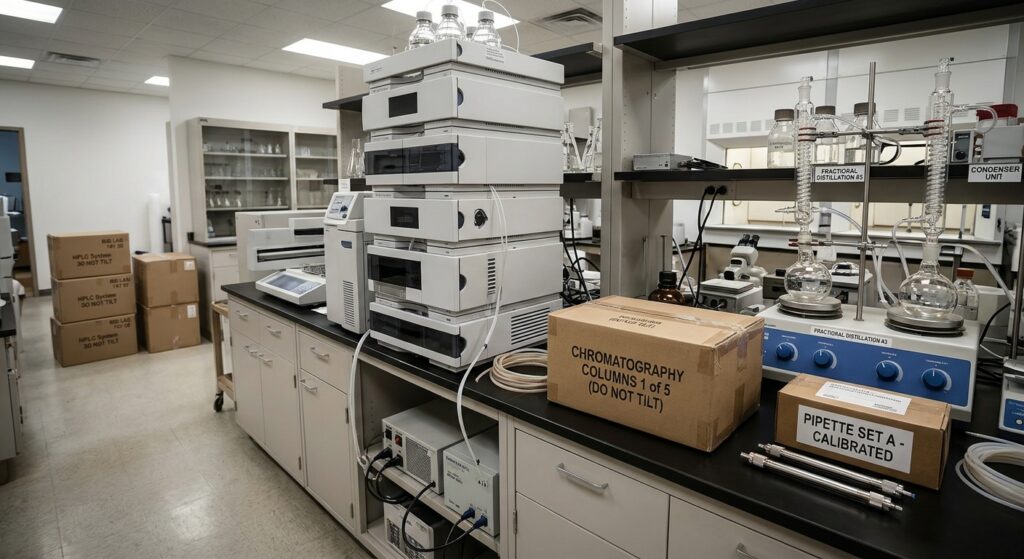
Briefing the moving crew
Even when every item has been cleared, the crew needs to understand what it is handling. A short written briefing, supported by a walkthrough on site, prevents most on-the-day problems. Cover these points:
- Which items are cleared and which are not. Cleared equipment carries a visible tag or notice, and anything without one stays where it is until the lab manager says otherwise.
- Which items must stay upright, level or unplugged until a specific moment. Many instruments and freezers have orientation or settling requirements.
- Who has authority on the day. One person from the lab and one from the moving company should be able to stop the work. Everyone else follows the plan.
- Where the hazards are. Even a decontaminated lab has glass, sharp edges, heavy doors and floor-level obstacles. Point them out.
- What the crew does if something spills, breaks or looks wrong. The answer should be to stop, keep people clear and call the named contact, not to improvise a cleanup.
Questions to ask a moving company before you hire one
A provider with real laboratory experience will answer these without hesitation and will usually raise a few of its own.
| Question |
What a good answer sounds like |
| How do you plan a lab move? |
A documented plan built from your inventory, with sequencing, access review and a named coordinator |
| How do you handle calibration-sensitive instruments? |
Coordination with the manufacturer, method chosen per instrument, not a standard wrap |
| What is your approach to cold storage? |
A written temperature plan, defined handoffs and a contingency for delays |
| Can you work with our safety office? |
Willingness to follow your clearance process and wait for sign-off |
| What happens after delivery? |
Placement according to your layout and support with reconfiguration |
| How are you insured for this kind of cargo? |
Specific coverage terms for equipment of this value, provided in writing |
| Can you work in phases? |
A plan for staged or multi-site relocations when the lab cannot close for a single weekend |
Ask for references from comparable moves, and ask what the provider would do differently on a project like yours. Providers who have done the work can usually point to a detail that the first plan missed.
What drives the effort and the budget
Lab relocation estimates vary widely because the variables vary widely. Rather than hunting for a single benchmark number, understand what moves the estimate up or down:
- The amount and sensitivity of the equipment, and whether manufacturer technicians are required
- Hazard classes present, which affect clearance work and waste disposal
- Cold storage volume and the complexity of the temperature plan
- Access conditions at both sites, including elevators, docks and distances
- Whether the move must be phased to keep part of the lab running
- Time needed for certification, calibration and verification afterward
A good estimate comes from a walkthrough and an inventory, not from a phone call. Treat any figure given without seeing the lab as a rough guess.
A working timeline
This timeline is a planning aid, not a standard. A single-room lab will compress it. A multi-lab facility or a lab with radioactive or high-containment work will extend it.
| When |
What happens |
| 6 to 3 months before |
Safety office notified, permits and registrations started, vendors identified, inventory begun |
| 3 to 2 months before |
Full inventory finished, manufacturer requirements collected, mover selected, destination layout approved |
| 2 months to 4 weeks before |
Chemical disposal and transfers, decontamination planning, cabinet and hood decontamination scheduled |
| 4 to 1 weeks before |
Packing materials ready, instruments prepared by manufacturers, cold storage plan confirmed, walkthroughs complete |
| Move week |
Final clearances, sequenced transport, cold chain handoffs |
| 1 to 4 weeks after |
Certification, calibration, verification runs, sample restoration, restart approval |
Common mistakes in lab relocation
| Mistake |
Consequence |
Prevention |
| Starting the safety conversation late |
Delayed clearance and added cost |
Notify the safety office when the date is set |
| Treating instruments like furniture |
Damage, voided warranties, lost calibration |
Involve manufacturers early |
| Forgetting that cabinets need recertification |
Work cannot restart on schedule |
Book the certifier for the arrival week |
| No documented plan for samples |
Loss of irreplaceable material |
Assign a named owner to the cold chain |
| Leaving unidentified chemicals until the end |
Testing and disposal delays |
Identify and segregate in the first weeks |
| Undocumented decontamination |
Disputes at move-out |
Keep photographs and signed records |
| Scheduling experiments immediately after the move |
Failed runs and wasted samples |
Build a stabilization period |
What a good lab move looks like
The lab stays in control of the science and the safety clearances. The safety office confirms that hazards are managed and documented. The manufacturers handle their own instruments. The moving company is briefed in detail, sequences the physical work and delivers each item to a marked place. Everyone shares one inventory and one timeline.
If your lab move is part of a wider office or facility relocation, the guide to planning an office relocation without losing productivity helps keep administrative areas and the lab on the same schedule.