People like to imagine a move as a neat little equation. You leave one home. You arrive at another. The truck drives directly between the two. Boxes go in. Boxes come out. Everyone sleeps in the new place that evening, slightly exhausted but quietly pleased with themselves.
Reality occasionally edits such stories. The closing date changes. Renovations take longer than promised. A landlord needs the apartment sooner than expected. The new house isn’t quite finished. Someone accepts a new job before the destination home is ready. Construction crews confidently announce they’ll be done next week, then continue making the same announcement for three additional weeks.
Buildings have interesting relationships with calendars. Suddenly the move develops a middle chapter.
People sometimes think needing storage means the move somehow went wrong. Quite the opposite. Many perfectly organized relocations include storage from the beginning because timing rarely asks permission before becoming inconvenient.
The interesting thing is that people usually don’t think much about storage until they unexpectedly need it. Then they think about it constantly. Where will everything go? For how long? Who has access? Will furniture remain protected? What happens if plans change again? Moving has always been rather good at creating follow-up questions. Storage simply introduces a few new ones.
Fortunately, they’re answerable.
The Common Scenarios Where Storage Becomes a Necessary Part of the Move
People often assume storage exists for people who own too much stuff. An understandable stereotype. Not especially accurate.
More often than not, storage solves timing rather than space. Timing has always been the trickier problem.
The New Home Isn’t Ready Yet
Perhaps renovations continue. Painters are still working. The flooring hasn’t been installed.
Construction schedules possess remarkable creativity. Rather than moving furniture into a home filled with ladders, paint cans, and people carrying power tools, temporary storage allows everything to wait safely until the house actually becomes a house again.
Fresh drywall dust has never improved anyone’s dining table.
Selling Before Buying
This happens more often than many people expect. Selling first may simplify finances. It also creates an awkward little question. Where exactly do your belongings live between transactions? Sometimes the answer involves family. Sometimes rental housing. Sometimes corporate relocation.
Quite often, the answer becomes “storage during a move”. Not because anyone planned poorly — because real estate transactions enjoy changing their minds.
Downsizing Doesn’t Always Happen Overnight
Imagine leaving a large family home for a smaller apartment. Some furniture fits beautifully. Some doesn’t. Some deserves thoughtful decisions before anyone parts with it.
Storage provides breathing room. That’s valuable. People make surprisingly good decisions when they aren’t making them under the cheerful pressure of a moving truck waiting in the driveway.
Time occasionally functions as excellent furniture polish. Not literally. Though that would be convenient.
International and Long-Distance Moves
Long relocations introduce additional layers. Shipping schedules. Travel delays. Temporary housing. Work assignments. Unexpected paperwork. Perhaps you’re relocating across the country but spending a month in furnished accommodation before permanent housing becomes available.
Dragging every belonging through three different addresses rarely improves the experience. Storage creates stability while everything else remains politely chaotic.
Life Occasionally Changes Mid-Move
Not every relocation follows the original script. Job offers appear unexpectedly. Family situations shift. Closing dates move. Medical needs arise. Weather develops opinions. The moving plan written six weeks ago quietly becomes historical fiction.
Storage doesn’t erase uncertainty. It simply gives uncertainty somewhere useful to sit while everyone figures out the next chapter. Oddly comforting.
Short-Term vs. Long-Term Storage — What Changes and What to Factor Into Cost
At first glance, storage sounds wonderfully simple. Put belongings inside a secure space. Retrieve them later. Done.
The details, as usual, possess richer personalities.
Short-Term Storage Lives on Flexibility
A few days. A couple of weeks. Perhaps a month or two. Short-term storage generally exists to smooth out temporary scheduling gaps.
The objective isn’t permanent organization. It’s continuity. Furniture remains packed. Boxes stay labeled. The expectation is movement, not settling in.
Think of it as a waiting room rather than a destination. Nobody decorates waiting rooms.
Long-Term Storage Asks Different Questions
Several months. Half a year. Longer. Now different considerations quietly step forward. Climate, humidity, pest prevention. Inventory management. Accessibility. Protective wrapping that seemed perfectly acceptable for two weeks may deserve reconsideration over several seasons.
Wood appreciates stable conditions. Artwork certainly does. Electronics have preferences too. Time gradually changes the conversation.
Packing for Time
Here’s something people occasionally overlook. Storage doesn’t freeze objects. Time continues. Temperature changes. Materials breathe. Cardboard ages. Plastic settles. Professional packing often adjusts depending on how long belongings are expected to remain stored.
A sofa waiting two weeks isn’t quite the same story as a sofa waiting eight months. Neither deserves poor protection. One simply deserves even more thoughtful preparation.
What Actually Influences the Price?
Naturally, everyone asks about moving storage cost. They should. The answer, predictably, depends on several pieces fitting together.
Storage volume. Duration. Climate-controlled versus standard storage. Accessibility. Location. Special handling and insurance. Packing services. Transportation to and from the facility. Some people require space for several boxes. Others temporarily store the contents of an entire five-bedroom home.
These situations naturally produce rather different invoices. Curiously, the cheapest option doesn’t always become the least expensive over time. Paying slightly more for proper protection occasionally prevents much larger expenses later.
Moisture has an unfortunate talent for generating expensive lessons.
Accessibility
Some storage arrangements make frequent access wonderfully convenient. Others are designed with the expectation that belongings will remain undisturbed until delivery day.
Neither approach is inherently better. They simply answer different questions. If you expect to retrieve holiday decorations every other weekend, one solution makes more sense. If everything stays sealed until your new home is ready, another probably does.
Choosing wisely begins with understanding your own habits.
Insurance Still Matters
Storage sometimes creates an interesting illusion.
Because belongings aren’t moving, people assume nothing particularly important is happening. Objects continue existing. Humidity continues existing. Accidents, while uncommon, continue existing too.
Understanding what protection applies while items remain in storage deserves exactly the same attention as understanding protection during transportation.
The boxes may be standing still. Responsibility doesn’t.
Portable Containers, Facility Storage, or Mover-Provided Options: How to Choose
Now the practical question. Where should everything actually go? There isn’t one perfect answer.
Different moves ask for different solutions.
Portable Storage Containers
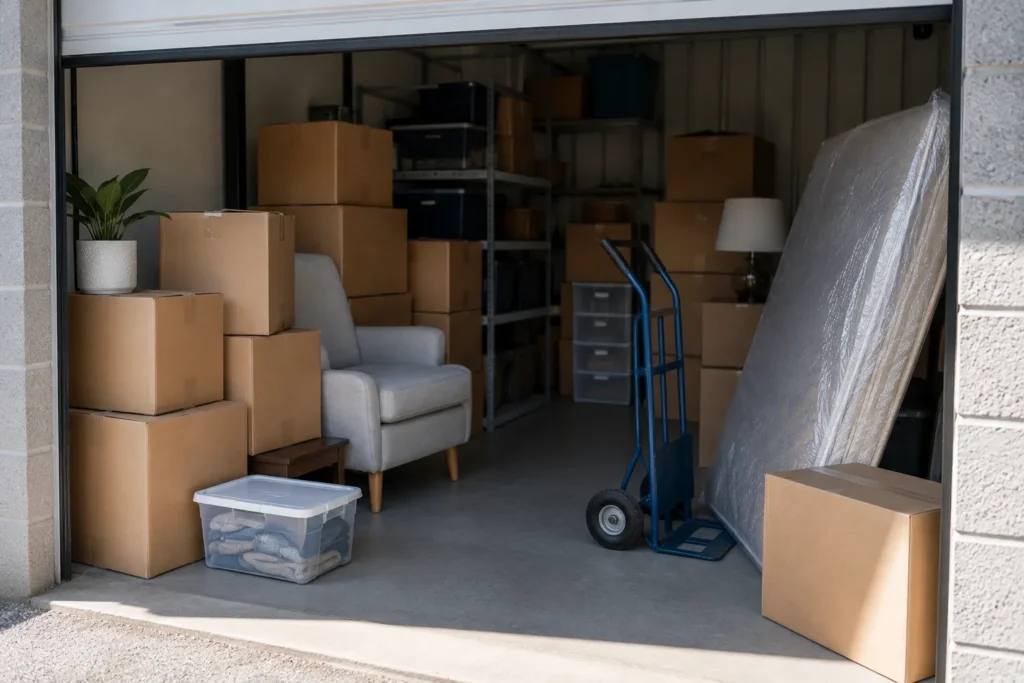
Portable containers appeal to many homeowners because they reduce repeated loading and unloading. The container arrives. You load it. It remains on-site for a period or travels to storage before later delivery.
Simple in theory. Often genuinely simple in practice. Still, consider access. Parking requirements. Neighborhood regulations. Security. Weather exposure while loading.
Not every driveway welcomes a large storage container with open arms. Some merely tolerate the relationship.
Traditional Storage Facilities
Self-storage facilities provide flexibility. Need access next Saturday? Generally manageable. Need to retrieve one specific box after two months? Also manageable. That convenience appeals to many people.
It does, however, mean someone usually loads belongings into the moving truck, unloads them into storage, then later loads them again before finally unloading everything into the new home.
Your furniture quietly accumulates extra introductions. Sometimes that’s perfectly acceptable. Sometimes minimizing handling becomes the priority.
Mover-Provided Storage
Hiring a moving company with storage often simplifies coordination. The same company manages transportation. Storage. Later delivery. Communication tends to become more straightforward because fewer organizations participate.
Fewer phone calls. Fewer schedules. Fewer opportunities for someone to confidently explain that another company is responsible.
Coordination has value. People occasionally notice that only after trying the alternative.
Think Beyond Price Alone
Storage decisions resemble moving decisions. Price matters. Security. Access. Professional handling. Inventory tracking. Insurance. Those pieces belong in the conversation too.
Choosing exclusively by monthly price occasionally resembles buying hiking boots based entirely on shoelace color. Technically related. Probably not the deciding factor.
Ask Better Questions
“How is my furniture protected while it’s stored?” “What happens if I need delivery earlier than planned?” “Can I access individual items?” “How are inventories tracked?” “Is climate control recommended for my belongings?” Specific questions usually uncover useful information. General questions often receive wonderfully polished marketing language.
Marketing has its place. Details have theirs.
Sometimes the Pause Is Part of the Journey
People often imagine moving as one uninterrupted motion. One address disappearing into another. Life rarely demonstrates such tidy choreography.
Sometimes there’s a pause. A useful one. The belongings wait while paperwork catches up. While construction finishes. While flights land. While new jobs begin. While families make decisions they didn’t expect to make six months earlier.
Storage isn’t really about putting possessions somewhere else — it’s about creating flexibility during a period that usually contains rather little of it. That’s why temporary storage solutions have become such an ordinary part of modern relocation. Not because people enjoy paying for additional services. Because life continues refusing to organize itself according to moving calendars. And honestly, it probably never will.